Sales strategies
This Is the Single Reason Sales Leaders Miss Their Number Today

Chris Orlob
Content Author
Published on: October 30, 2017
Last modified on: March 4, 2026
It’s not a lack of leads.
It’s not inefficiency.
It’s not even sales effectiveness (at least, as it’s generically defined). It’s more specific than that.
It’s the “Sales Performance Gap.”
This is the (vastly misunderstood) delta that separates the top 20% of your sales force from everyone else, creating a performance bell curve that looks like this:
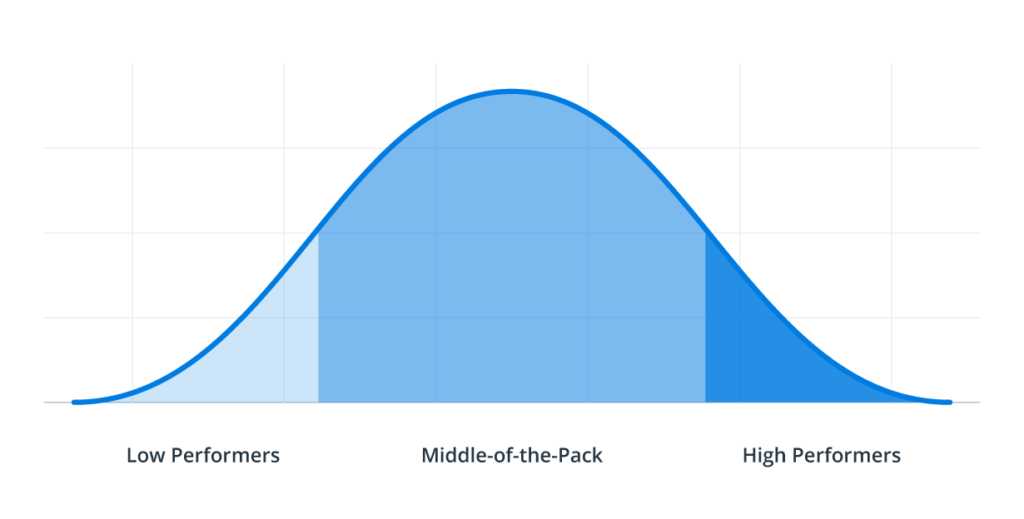
This divide wreaks havoc on your ability to make your number, your cost of sale, rep turnover, and even your job tenure as a sales leader.
And here’s the big kick in the pants…
Across most sales organizations, this gap is actually gettingwider, not smaller.
The average percentage of B2B sales teams attaining full quota is gradually shrinking each year:
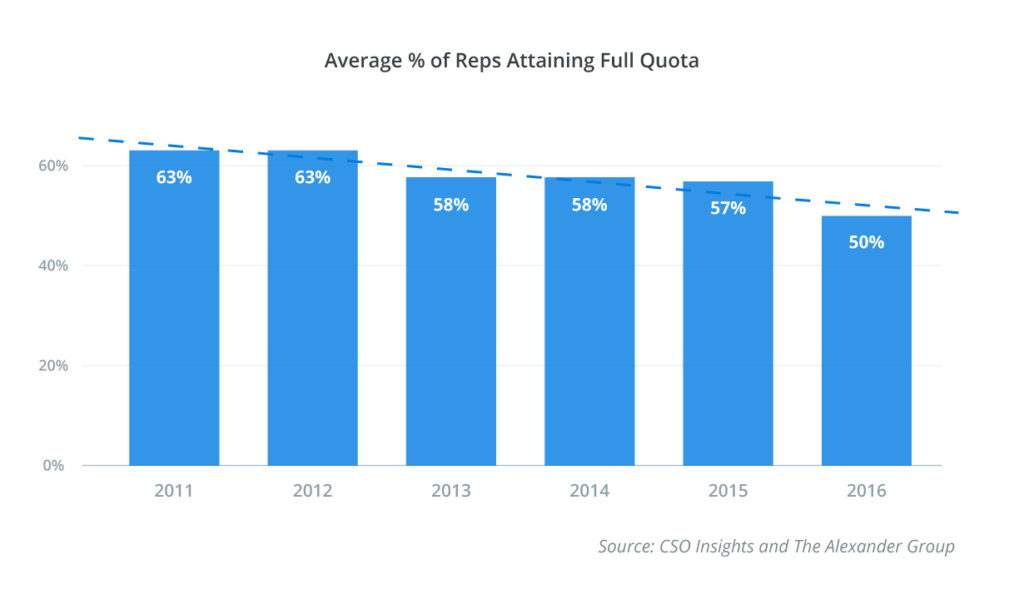
Despite this,annual quotascontinue toincreasefrom year to year (7.5% per year for the last two years according to Sibson Consulting).
Ask yourself:do you expect next year’s number to be bigger, smaller, or about the same?
Here’s What This “Gap” Is Costing You
This delta between performance echelons has some pretty horrific costs when you examine it more closely.
Opportunity Cost: Hundreds of Lost Deals
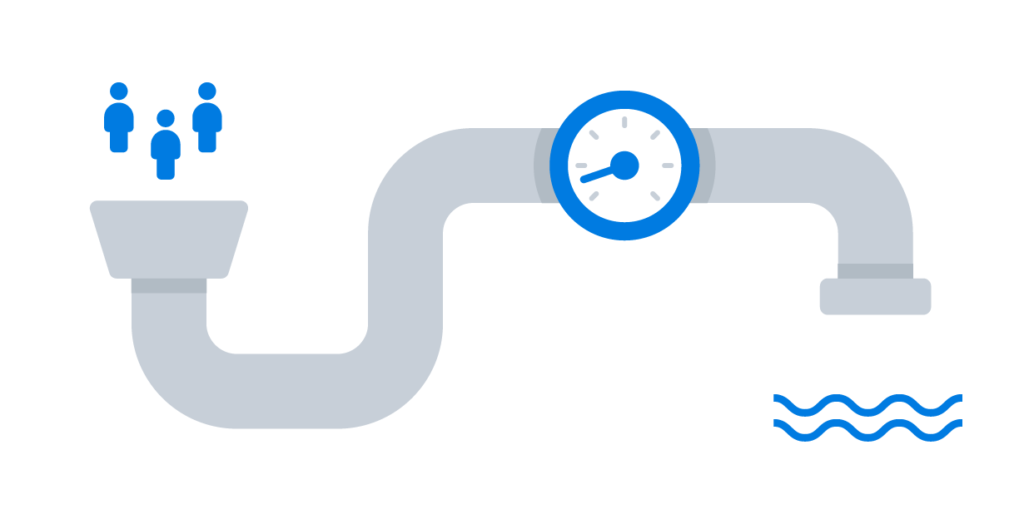
The fact that most of your sales force is performing at a “b-level” (which is usually around 80% of quota) meanshundredsof qualified opportunities get poured into the pipeline but fail to materialize into revenue.
These are all deals thatcouldhave closed,shouldhave closed,but didn’t.
Think about the volume of qualified deals thatwouldclose if every rep that makes up your “middle of the pack” had just a5%higher close rate?
As someone with a vested interest in ensuring leads eventually close, that makes my stomachchurn.
Your Cost of Revenue Soars
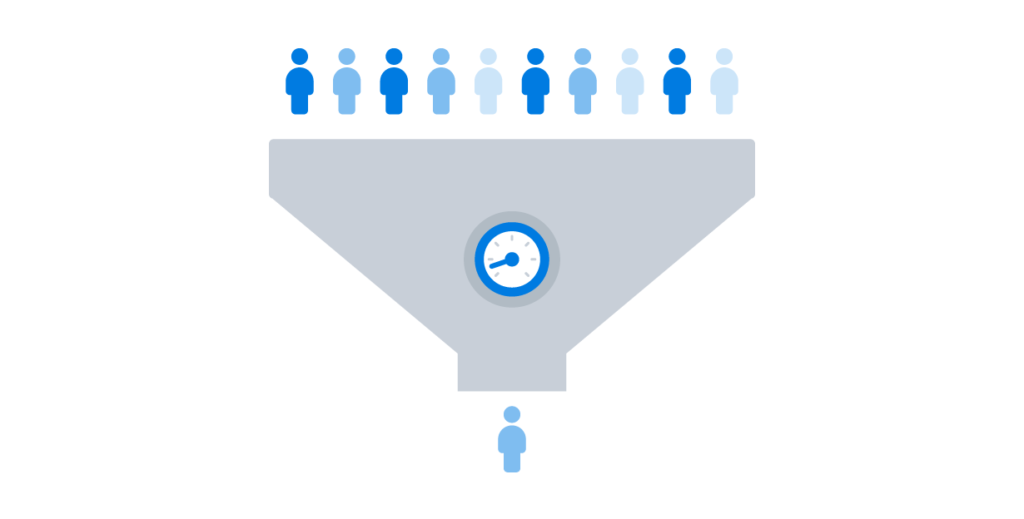
The middle-of-the-pack, of course, do close deals. But they have to wade their way through many more lost deals than star performers do before they finally get a win.
For the deals thatdoclose, they come with longer sales cycles and smaller average deal sizes.
These factors combined drive up your cost of revenue. More leads are required to get smaller deals over a delayed period of time.
Rep Turnover: The Gap Creates the Dreaded Revolving Door
26% of rep turnover is due to missed quotas .
That becomes an incredibly costly problem when you account for hiring costs, compensation, severance, and the hundreds of wasted, dead-in-the-water deals.
This amounts to an average cost per turnover of $97,690 .
That’s a number any VP of Sales or CEO should be concerned about.
Sure, some of that’s a hiring problem.
But most of the hiring part of this issue has to do with your “C-Players” (the bottom 20%), not your “middle 60%.”
These middle reps, by definition, are reps thathavehigh potential, havedemonstratedhigh potential (unpredictably), but haven’t yet figured out how to operateconsistentlyat that level.
Introduce consistency to your middle-of-the-pack, and you can go anywhere you want.
Sales Leaders Are Getting Fired Over This
The downward quota attainment trends discussed earlier are happening at the same time that the sales leaders’ average tenure is shrinking.
Once standing at a healthy 26 months, it’s now made its way down to just 19 months.
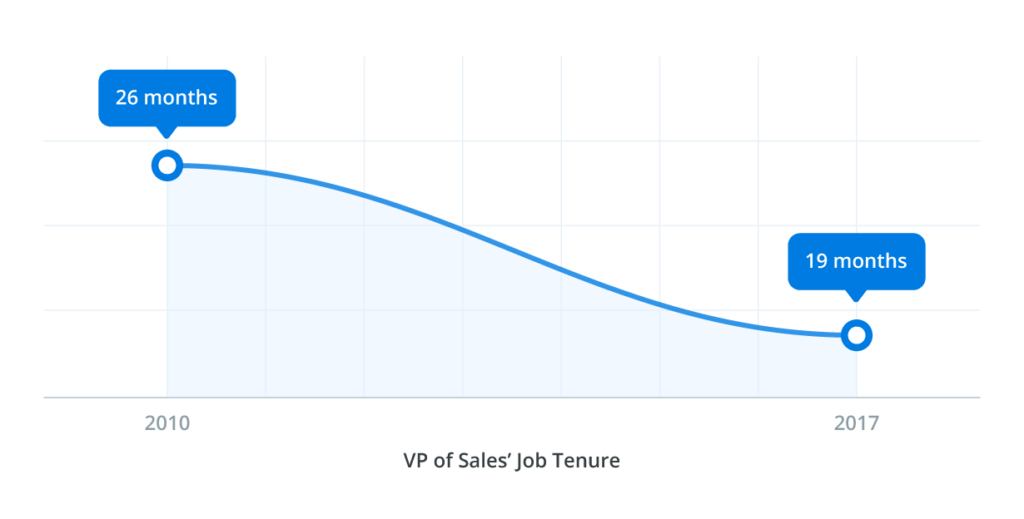
That amounts to a few quarters getting up to speed, a few quarters giving it the old college try, and a few quarters planning your “exit strategy.”
Any seasoned sales leader will admit that the widening performance gap and a dwindling sales leader tenure are strongly intertwined.
Here’s Why Shifting the “Middle of the Pack” Solves These Problems
Your ability to consistently grow revenue as a sales leader will rise and fall on how well you can shift the middle of this performance bell curve.
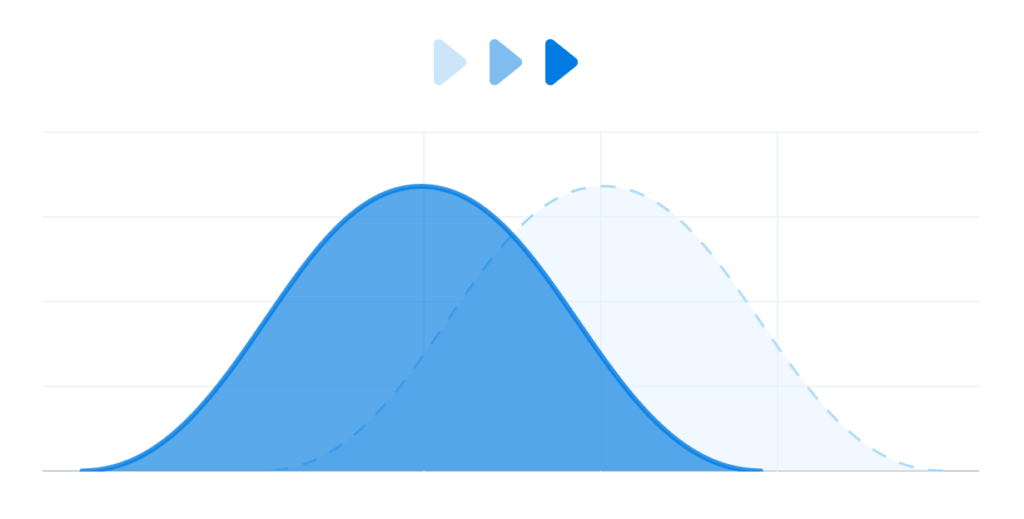
That’s where the leverage lies.
Focusing on your “A-players” is important for the sake of retaining them.
But they have much less room for improvement, and they make up a small population of your sales force. As a result, there isn’t much leverage.
The real goal should be to isolate your star performers’ successful behaviorsand scale them to the rest of your team.
Focusing on your “C-players” ismisdirectedeffort.
It’s a hiring problem, not an effectiveness problem. You can’t coach or train away a poor fit for a job.
If someone is performing significantly below what’s acceptable, the focus should be on placing them in a role that suits them better.
But if you can get a 5% performance gain out of your “middle 60%,” that equates to 70% more revenue than if you got a 5% performance gain out of your top reps.
Getting to the Root of the Sales Performance Gap
The gap is a problem as old as the sales profession itself.
This is because conventional approaches fail to address the root cause of the problem.
In my next post, I talk aboutwhy the gap exists and the single factor that separates your star salespeople from the rest of your team.
This will give you thefoundational insightto be able to solve the problem.
So, I have astrongrecommendation for you as a next step…
We’ve established that “the gap” is a glaring problem that needs to be solved.
In this next post, we’ll address the root cause of the problem, which is “STEP ONE” in solving it.
Without this knowledge,nothing you do is going to work.
Let me repeat:conventional solutions willfailif they don’t address the root of the problem.
Check out the next post HERE , and we’ll talk to you soon.

Content Author
Chris Orlob is the Co-Founder and CEO of Pclub.io, a leading sales training platform designed to help sales professionals accelerate their revenue growth. He is best known for his pivotal role at Gong, where he helped scale the company from $200,000 to $200 million in ARR, contributing to a $7.2 billion valuation. During his tenure at Gong, Chris led the creation of Gong Labs and excelled in various go-to-market roles. Today, through Pclub.io, he leverages his deep expertise in sales and revenue operations to coach over 11,000 SaaS sellers.
Win more with Gong
Loading form...
Discover more from Gong
Check out the latest product information, executive insights, and selling tips and tricks, all on the Gong blog.