How to build revenue projections that sales leaders can trust

Michael Rosenson
Sr. Manager, Strategy & GTM BizOps
Published on: September 8, 2025
Last modified on: March 4, 2026

One delayed deal can throw off your entire forecast. But if you’re a revenue leader, it’s not just your forecast that’s on the line — it’s your credibility too. Nothing raises eyebrows faster than a deal that’s set to close this quarter, slipping into the next.
Most revenue projections fail because they assume deals will close as planned. But deals don’t always behave. Buyers go silent. Procurement delays happen. Decision-makers change roles. If your projections don’t account for deal slippage, you’re left scrambling for answers in front of your board.
This guide will show you how to create accurate, defensible revenue projections that stand up to boardroom scrutiny. You’ll learn how to spot at-risk deals, build multi-scenario projections, and improve forecast precision — even when deals don’t behave as expected.
What are revenue projections?
Revenue projections are estimates of future revenue based on current pipeline data, historical performance data, and market trends. Revenue leaders use them to:
- Understand deal health
- Predict revenue
- Prepare for executive and leadership accountability
Importantly, they also directly influence key business decisions like hiring, budgeting, and expansion planning. Getting them wrong can be extremely costly.
If you don’t get your forecasting right — and let’s just focus on sales forecasting — it can have real impacts on your planning and your future. And whether you forecast too high or too low, if you don’t get it right, it can have a really adverse impact. And in a SaaS business where we’re usually forecast on bookings, bookings is a really leading indicator to future performance of revenue of the company.
If you don't get your forecasting right — and let's just focus on sales forecasting — it can have real impacts on your planning and your future. And whether you forecast too high or too low, if you don't get it right, it can have a really adverse impact. And in a SaaS business where we're usually forecast on bookings, bookings is a really leading indicator to future performance of revenue of the company.
Diego Panama
Former Chief Commercial Officer at LiveRamp

If projections are too optimistic, companies risk over-hiring or falling short of ambitious growth targets. This happened to 63 percent of businesses in the first half of 2023. On the other hand, overly cautious projections can stifle growth by leaving opportunities on the table.
That’s why revenue projections should be dynamic. They empower revenue leaders to forecast more accurately, avoid surprises, and build lasting stakeholder trust.
The 3 most important metrics for accurate revenue projections
Three metrics form the backbone of accurate revenue projections. Without them, your forecasts and decisions could miss the mark. Here’s what you need to focus on:
1. Deal health: Which deals are at risk?
This is about knowing what’s happening in your pipeline at any given moment. Why is that important? Because if 40 percent or more of your revenue depends on just 5-10 large deals, even one delay can disrupt everything. You need to know if those deals are on shaky ground, because if they are, revenue slippage is inevitable.
By tracking deal health, you won’t be caught off guard. You can see which deals are likely to close, which are in jeopardy, and how to stay ahead of potential slippage so you’re always ahead of the curve.
2. Pipeline coverage: Are you safe for the current and future quarters?
Pipeline management sets the stage for your success or failure before the quarter even starts. Without enough coverage, hitting your numbers and generating revenue growth is nearly impossible. That’s why 3x pipeline coverage (i.e., 3x your quota) is often considered the gold standard, though this varies by industry and business model.
Why is 3x coverage considered the benchmark?
Coverage below this threshold puts intense pressure on your team to close every deal or generate pipeline, increasing the risk of missed targets. But too much coverage can be problematic, too. Ratios above 5x often signal a bloated pipeline that’s inflated by unqualified or stale deals.
As always, balance is key.
( Image Source )
3. Buyer engagement: Have your buyers gone silent?
While Buyer Engagement technically falls under Deal Health, it’s also important to break it out separately since it’s such an important signal.
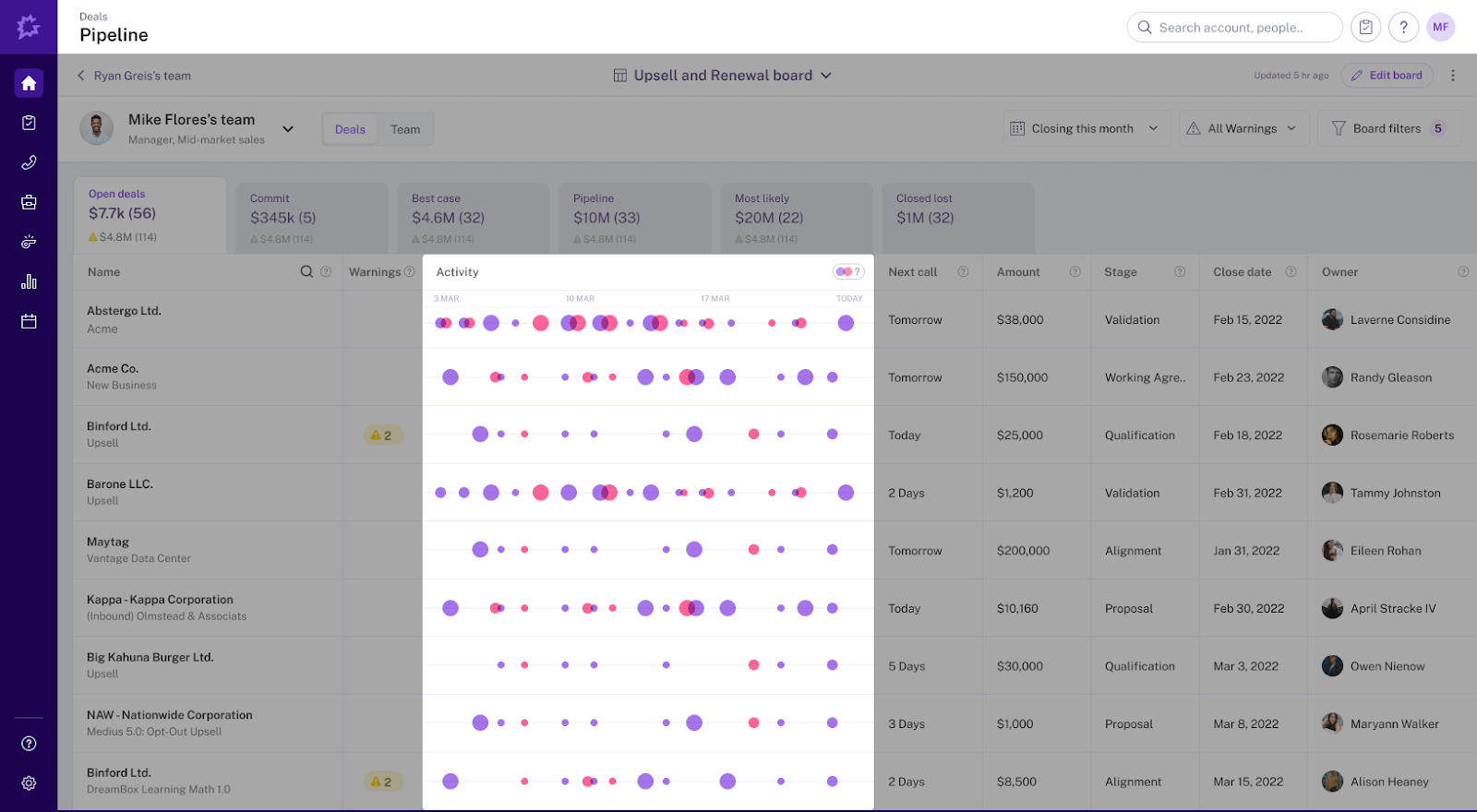
Deals die when buyers go silent. If they don’t respond to emails, attend meetings, or review proposals, their deals probably won’t close on time. In fact, customer indecision delays 87 percent of sales opportunities .
High buyer engagement — like quick replies or frequent document views — means you’re in a strong position to close. But if engagement drops, especially with no activity for two weeks, it’s a red flag. That deal might not close as planned, and you may need to adjust its timeline.
Tracking buyer engagement ensures that you can identify at-risk deals early and adjust your revenue forecasts accordingly to avoid surprises.
The 3 best revenue projection models for revenue leaders
Having the right projection model can make the difference between hitting your revenue goals and falling short. But how do you decide which model is right for you? Here’s a look at the top three:
Model 1: Pipeline-driven projections
Best for:SaaS companies, high-velocity sales, and sales teams with large pipelines
This model uses real-time pipeline visibility to update projections as deals progress, so if deals slip, your forecast adjusts immediately. Here’s how to use it:
- Use deal health scores in deal management software to evaluate each deal. They’re data-backed and highly accurate.
- Not all pipeline deals are created equal. Assign higher probabilities (80-90 percent) to deals with strong buyer engagement, and lower probabilities (20-40 percent) to riskier ones.
- Combine the weighted deals into a total revenue projection.
Model 2: AI/(ML) machine learning-driven projections
Best for:Large teams, complex pipelines, and AI-driven companies
This model uses AI and machine learning to automatically track deal risk, customer behavior, and pipeline health in real time. Here’s how it works:
- Sales intelligence tools analyze patterns from thousands of deals, tracking buyer engagement and CRM activity to assess deal health.
- The system automatically identifies risky opportunities and predicts which deals might slip.
- As deal health fluctuates, the AI updates projections instantly, making them more accurate than human judgment alone.
Model 3: Scenario-based projections
Best for:Enterprise sales, board meetings, and complex deals with high uncertainty
In revenue projection meetings, the first question is often, “What’s the worst-case scenario?” A scenario-based model answers that question with three variations.
Here’s how to make it work:
- Define your three scenarios. For example:Best case:All “Commit” deals close, and 80 percent of “Upside” deals close.
- Most likely case:A full 90 percent of “Commit” deals close, and 60 percent of “Upside” deals close.
- Worst case:Only 50 percent of “Commit” deals close, and none of the “Upside” deals close.
- Assign closure probabilities to each scenario to better understand the risks.
- Use these scenarios to explain variances, showcase preparedness, and build trust with your leadership.
Because each model serves a different purpose, the most experienced revenue leaders typically combine them to create projections that are accurate, defensible, and board-ready.
( Image Source )
How to build reliable revenue projections
Reliable revenue projections don’t happen by chance — they’re the result of a thoughtful, data-driven process. With the right approach, you can create accurate forecasts that guide strategic decisions andbusiness growth. Here’s how to get started with the revenue forecasting process:
1. Start with complete, unbiased data
Accurate revenue projections depend, in large part, on good data. For data to be trustworthy, it must be complete, up-to-date, and unbiased. Here’s how to ensure that’s the case:
- Regularly clean up data for stale opportunities, missing close dates, and deals stuck in the wrong stage. (Better yet, use a platform that tracks that data for you so you’re never dependent on reps to enter the right data at the right time.)
- Ensure that all sales reps adhere to your chosen sales methodology so there’s no ambiguity about what “Stage 3” means.
- Ask sales managers to double-check close dates on key deals, especially those marked as “Commit” or “Likely to Close.”
- Use revenue AI tools to flag deals without buyer activity for 14+ days. Silent buyers signal risk, so those deals may need extra attention or revised timelines.
2. Leverage an intelligent revenue platform or AI-driven revenue solution
Not every revenue model fits every business. That’s why leading revenue teams rely on intelligent platforms and AI-driven solutions to adapt and refine their forecasts. These tools allow you to use multiple models in parallel, ensuring your projections are accurate and defensible.
Pro tip:Don’t rely on just one model. Instead, use all three — pipeline-driven, AI/ML-driven, and scenario-based — to triangulate your results. This multi-scenario approach improves forecast precision and makes it easier to justify projections with clear, data-driven insights.
3. Identify the most important inputs for your revenue projection
To avoid missed forecasts, focus on key metrics that help you identify potential risks early, including:
- Deal health
- Pipeline coverage
- Buyer engagement
- Win rate by segment (not overall)
- Sales cycle length
- Stage progression
- Pipeline velocity
Pro tip:If you have 3x pipeline coverage but 40 percent of your deals have silent buyers (i.e., buyers who have gone quiet), your pipeline is weaker than it looks. Adjust your projections for these hidden risks.
4. Build real-time revenue projections
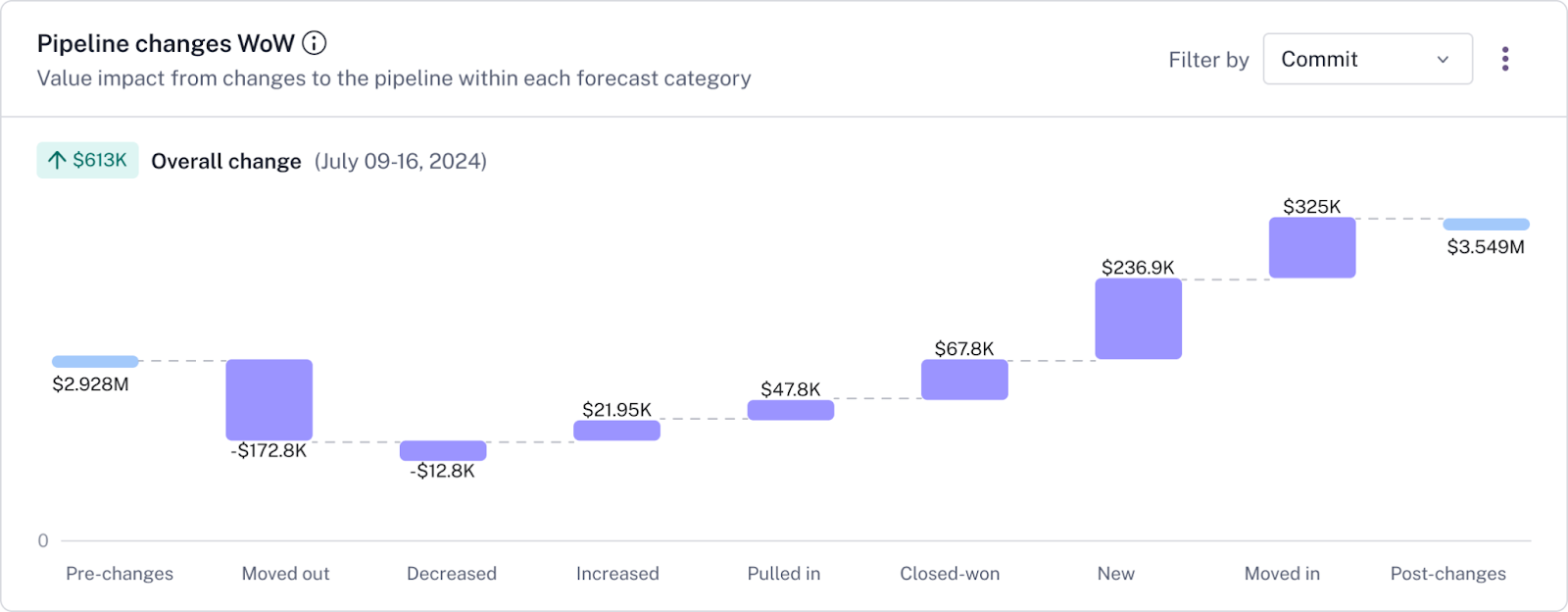
End-of-quarter updates are too late to save your forecast. By that point, any chance of course-correcting is gone. If a key deal slips into the next quarter, your projection must reflect that change immediately. Otherwise, you risk missing targets.
To stay ahead, use forecasting methods and tools that can keep your projections accurate and up-to-date. Build a rolling 12-week forecast that updates anytime deal health or buyer sentiment changes. And when deals show signs of slipping, you can adjust their closing probabilities automatically.
5. Segment your revenue projections
Global projections are often misleading. Enterprise, SMB, and mid-market deals have unique dynamics, and lumping them together can result in inaccurate sales forecasts. The most effective revenue leaders segment their projections to account for these differences and apply different win rates, sales cycles , and risk factors to each group.
Here’s how segmentation can improve accuracy:
- By deal size:SMB deals tend to close faster and have higher win rates, while enterprise deals typically take longer and have lower win rates.
- By geography:Win rates and sales dynamics often vary by region.
- By sales source:Inbound deals tend to outperform outbound deals in both in both win rates and sales cycle length.
Pro tip:Use segmentation to explain variances in board presentations. For example, say, “Enterprise deals slipped due to procurement delays, but SMB deals are on track,” instead of simply stating, “We missed our forecast by 10 percent.”
( Image Source )
Questions every revenue leader should ask when reviewing projections
To avoid surprises in board meetings, challenge your financial projectionsbeforethe meeting with these critical questions:
Deal risks:
- Which deals are at risk of slipping?
- What’s the worst-case scenario?
- Are we relying too heavily on a few large deals?
Pipeline health:
- Is next quarter’s pipeline strong enough to meet our financial goals?
- Do we have enough early-stage deals to replace lost opportunities?
- Is deal velocity improving or slowing down?
Forecast reliability:
- Are we using real-time data or outdated, static forecasts?
- Are our assumptions overly optimistic?
- Are our assumptions excessively cautious?
These questions help you identify risks, validate assumptions, and deliver accurate projections.
Don’t just predict revenue — control it
Most revenue projections miss the mark because they expect deals to follow the script. But if you’ve been in sales long enough, you know that deals don’t always behave. So why do so many revenue leaders put their reputation on the line with forecasts that ignore slippage?
If you’re tired of surprises, you need a way to build projections you can rely on. That means:
- Tracking deal health in real time so you can stop guessing which deals are safe.
- Monitoring buyer engagement to pinpoint silent buyers who put deals at risk.
- Building best, worst, and likely case scenarios, because leadership will ask, “What’s the worst that could happen?”
When you track these factors, you’re no longer predicting revenue — you’re controlling it. And Gong Forecast is how you’ll do it.
Ready to take control? Book a demo today .
Sr. Manager, Strategy & GTM BizOps
Michael Rosenson is a Sr Manager of Strategy & Insights at Gong. Michael leads global pipeline target setting and performance management & is a key partner in the development of Gong’s Revenue Analytics platform.
When he’s not digging for insights gold, Michael enjoys practicing his dad jokes on his two kids (who find him very funny).
Win more with Gong
Loading form...
Discover more from Gong
Check out the latest product information, executive insights, and selling tips and tricks, all on the Gong blog.