Analyst insights
The next chapter of revenue AI: lessons from two years as a Gartner Magic Quadrant Leader

Eilon Reshef
Chief Product Officer & Co-Founder at Gong
Published on: October 26, 2026

A year ago, Gartner published the first-ever Magic Quadrant for Revenue Action Orchestration (RAO). At the time, the category was still taking shape, emerging from the convergence of sales engagement, conversation intelligence, and revenue intelligence.
A lot has changed in the past year. AI agents went from demos to daily work. Sellers started using enterprise AI assistants alongside their core tools. And the question every revenue leader asks us shifted from "What can AI do?" to "Can I trust what it's telling my team?"
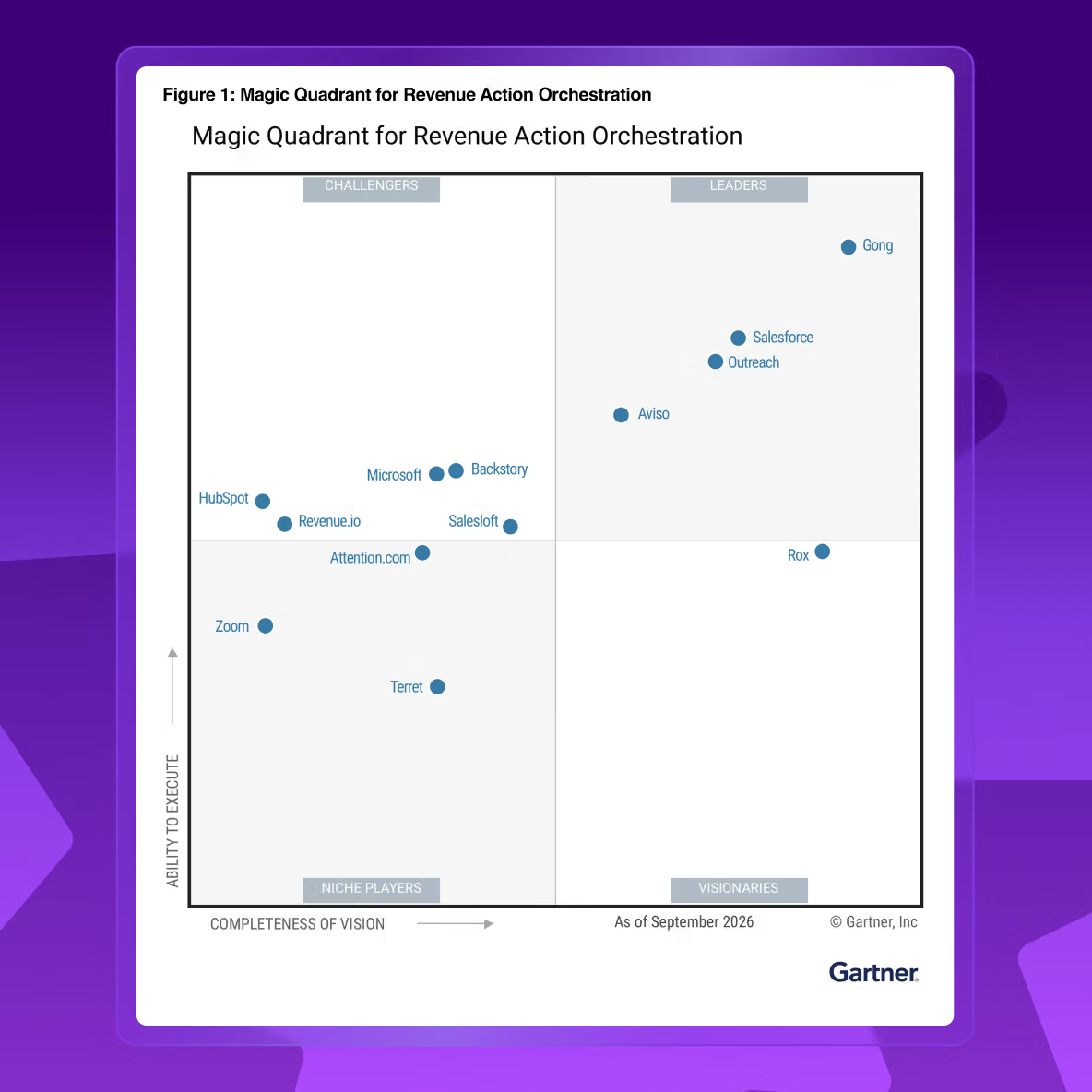
As the market has changed, so have we. Our focus has stayed the same: building Revenue AI our customers can trust, and that delivers real outcomes. We believe that’s why Gong has been named a Leader in the 2026 Gartner® Magic Quadrant™ for Revenue Action Orchestration for the second year in a row.
Where revenue AI is heading
The most interesting part of this year's report, to me, is the direction of the market. Gartner describes a shift from application-centric platforms to context-centric ones, and says Leaders are building toward "context as a service." We agree, and it's how we've been building Gong from the start. Here's how we see the next phase of this category.
1. AI is only as good as the context it gets
Almost everyone has pasted a call transcript into an LLM and asked what to do next. You get an answer. It's usually generic: follow up, send a recap, schedule a next meeting.
Real deals don't live in a single call. The risk in a deal might show up in an email from procurement a week later, or in a security review that never touched a meeting. Useful AI needs the whole picture: conversations, emails, CRM data, and external market signals. Each piece also has to be mapped to the right account and the right opportunity. That mapping is one of the hardest problems in revenue AI, and it's the job of the Gong Revenue Graph. Context also has to be usable, not just stored. Two examples of how that works in Gong today:
- AI Data Extractor listens to calls and emails, identifies key deal and account details, and fills in CRM fields automatically. Reps don't have to type anything, and the CRM reflects what customers actually said, not what someone remembered to log.
- AI Tracker finds the moments that matter across every conversation, even when people phrase them differently. A team can ask a question in plain language, like "Is the prospect asking for a discount?", and see every conversation where it happened. Those signals then show up in search, alerts, dashboards and deal views.
Gartner calls out "AI slop" as a real risk to adoption: generic, ungrounded output that sellers quickly learn to ignore. The fix isn't a better prompt. It's better context.
2. Governance is what makes revenue AI work
Consumer AI has simple rules: you see your own data. Revenue doesn't work that way. A seller on an account team might need every interaction with that customer from the last three years, but nothing from a territory they don't cover. Some calls, like legal discussions, shouldn't be recorded at all. And a rep's inbox contains plenty that should never reach a corporate system.
Getting this right isn't glamorous, but it's the foundation. Without careful rules about what gets captured and who can see it, you can't put AI in front of a revenue team responsibly. That's why every Gong agent runs within the Gong Revenue Harness, with built-in business context, permissions, oversight and auditability.
3. Agents are moving from answering questions to doing the work
We think about AI in revenue in generations. First came assistants you ask questions. Then came agents that automate tasks when something happens, like a deal closing or a new lead arriving. The next generation is proactive: agents that continuously watch an account or a deal, compare it with what has worked before, and tell sellers (or other agents) what matters most right now.
B2B deals involve many sellers, many buyers, and many goals. Ultimately, we believe the best approach is to learn from outcomes: study what actually happened in won deals and successful expansions, turn that into a plan, and let agents track progress against it. That's how recommendations go from generic to specific enough that a seller actually wants to act on them.
4. Open by design, with humans in control
Gartner notes that revenue platforms are increasingly exposing their context to CRMs, collaboration tools and enterprise AI assistants. Many of our customers already call Gong agents from their own tools through MCP and APIs, and we think that's exactly right. Revenue context should flow to wherever people work.
But people won't chat their way through every task. Sellers still need a place to plan their week, decide which recommendations to act on, approve what agents do, and work through deals with their colleagues. No agent should email your largest customer without someone signing off. The future workspace is a shared one, where people and agents work side by side and people make the final call.
What this year's Magic Quadrant says
For the second consecutive year, Gong is positioned highest on the Ability to Execute axis and furthest on the Completeness of Vision axis.
In the report, Gartner notes that Gong's products "scored in the top tier across all RAO critical capability use cases," and describes Gong as a fit "for organizations that prefer to standardize multiple sales functions on a single RAO platform."
We believe that reflects what our customers tell us every day: they don't want another point solution. They want one agentic system that runs prospecting, deal execution, forecasting, and coaching on the same foundation.
Gartner also highlights our industry strategy, including our focus on manufacturing, professional services, financial services and life sciences. That matters to us. Revenue AI has to understand your business: how a bank sells, or how a medical device company sells, not just how a software company sells.
Building it together
Being named a Leader again is a milestone, but it isn't the end goal. The goal is helping revenue teams win more and drive better outcomes. That only happens because our customers push us, test what we build, and tell us when we get it right or wrong. This recognition belongs to you, our customers, as much as to our team.
Download the full 2026 Gartner Magic Quadrant for Revenue Action Orchestration to explore the complete analysis.
*Gartner, Magic Quadrant for Revenue Action Orchestration, By Steve Rietberg, Alyssa Cruz, Dan Gottlieb, 13 October 2026.
GARTNER is a registered trademark and service mark of Gartner, Inc. and/or its affiliates in the U.S. and internationally, and MAGIC QUADRANT is a registered trademark of Gartner, Inc. and/or its affiliates and are used herein with permission. All rights reserved.
Gartner does not endorse any vendor, product, or service depicted in its research publications, and does not advise technology users to select only those vendors with the highest ratings or other designation. Gartner research publications consist of the opinions of Gartner's research organization and should not be construed as statements of fact. Gartner disclaims all warranties, expressed or implied, with respect to this research, including any warranties of merchantability or fitness for a particular purpose.
This graphic was published by Gartner, Inc. as part of a larger research document and should be evaluated in the context of the entire document. The Gartner document is available upon request from Gong.
Chief Product Officer & Co-Founder at Gong
Eilon Reshef is the Co-Founder and Chief Product Officer at Gong, the leading platform in the revenue intelligence space. Since co-founding Gong in 2015, Eilon has spearheaded its product and engineering efforts, transforming how sales teams harness data to drive success. Gong uses AI to analyze sales interactions, offering actionable insights that help businesses grow revenue. Prior to Gong, Eilon co-founded Webcollage, a SaaS platform for e-commerce infrastructure. With deep expertise in product strategy and AI, Eilon is a key figure in advancing sales technology and operations.
Win more with Gong
Loading form...
Discover more from Gong
Check out the latest product information, executive insights, and selling tips and tricks, all on the Gong blog.