Sales strategies
How to master competitive selling and win every time

Chris Orlob
Content Author
Published on: June 15, 2018
Last modified on: March 4, 2026
Selling is a zero-sum game. While you’re popping a champagne bottle because you know how to sell against the competition, your competitor is downing cheap whiskey to mourn their loss.Either way, when the drinks are done, you’ll both go back to square one with the same goal:Sending your competitors home with their tails between their legs.To do that, you have to understand the first principle of competitive selling:
Differentstrategies win indifferentcompetitive scenarios.
In other words, the skill does not lie inknowing the strategies.The skill lies inknowingwhich strategies apply to which situations.If you compete in amaturemarket, you’ll need a different strategy than if you compete in anew market.Our data makes that clear.The data science team at Gong.io used AI to analyze 24,077 competitive deals and the sales conversations that span those deals.Those conversations were recorded, transcribed, and analyzed with AI, then matched against their CRM opportunities so we could assess the results.The database for this study included two types of selling organizations:
- Those inmature marketswithmanycompetitors.
- Those innew marketswith only a few (but strong) competitors.
As you’ll see, the winning strategy is different for each situation. [newsletter]
The Winning Strategy Depends on Market Type
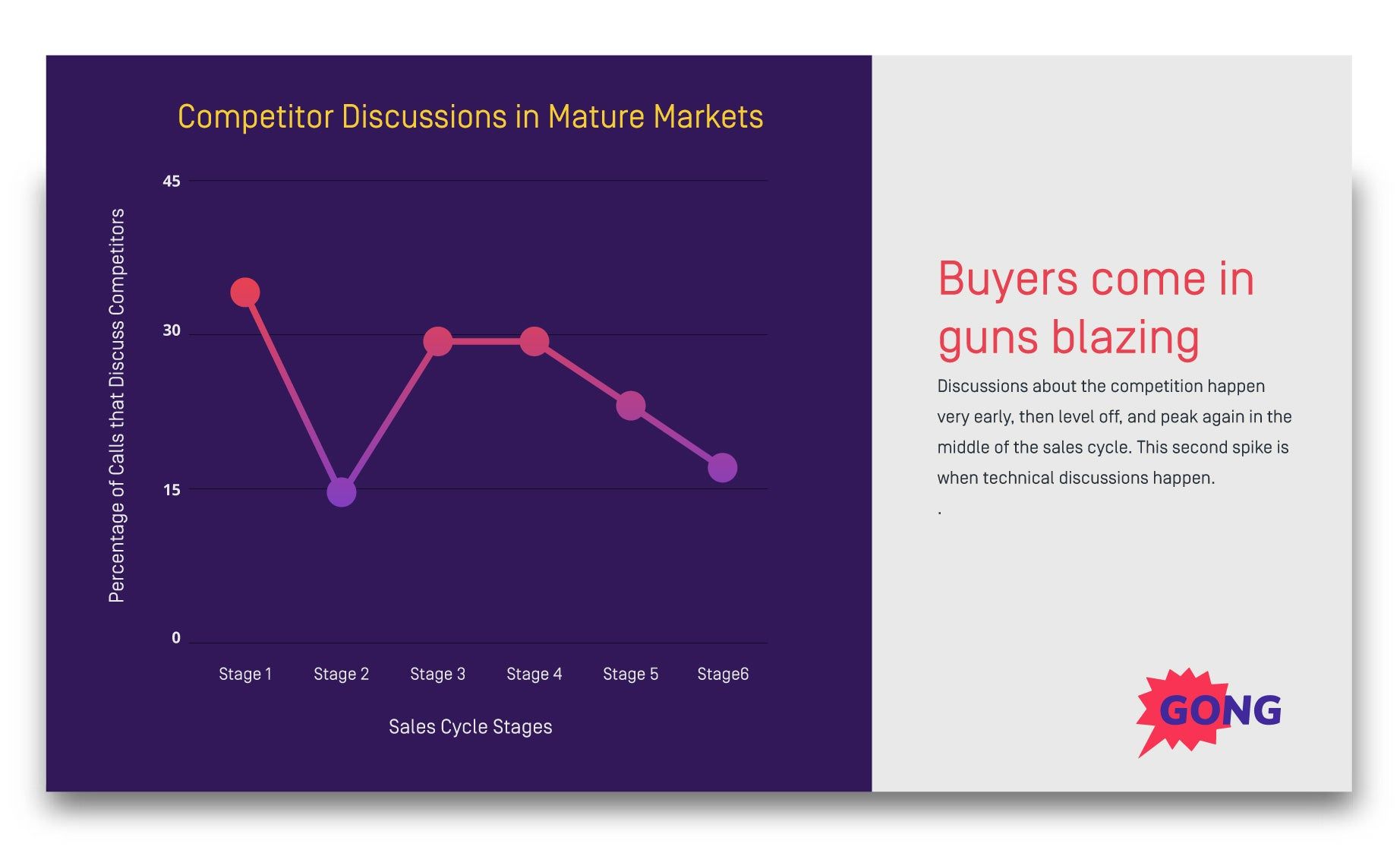

Take a look at when the competition is discussed (on average) in a mature market sales cycle:Buyers enter the sales cycle guns-a-blazing, immediately discussing the competition with the sales rep.Discussions about the competition then level off, and peak again in themiddleof the sales cycle duringtechnical discussions.They then diminish for the rest of the cycle until the deal is won or lost.The competitive dynamics in new markets are very different:Buyers and reps innew marketsusually discuss competitorslate in the sales cycle.Competitor discussions get some activity early on, with a “competitive radio silence” that haunts the middle of the sales cycle.Since the dynamics are so different in these two markets,the winning approach also has to be different.
Selling Against the Competition inMatureMarkets
If you sell in a mature market, here’s your first rule of thumb:
Competition is BAD.
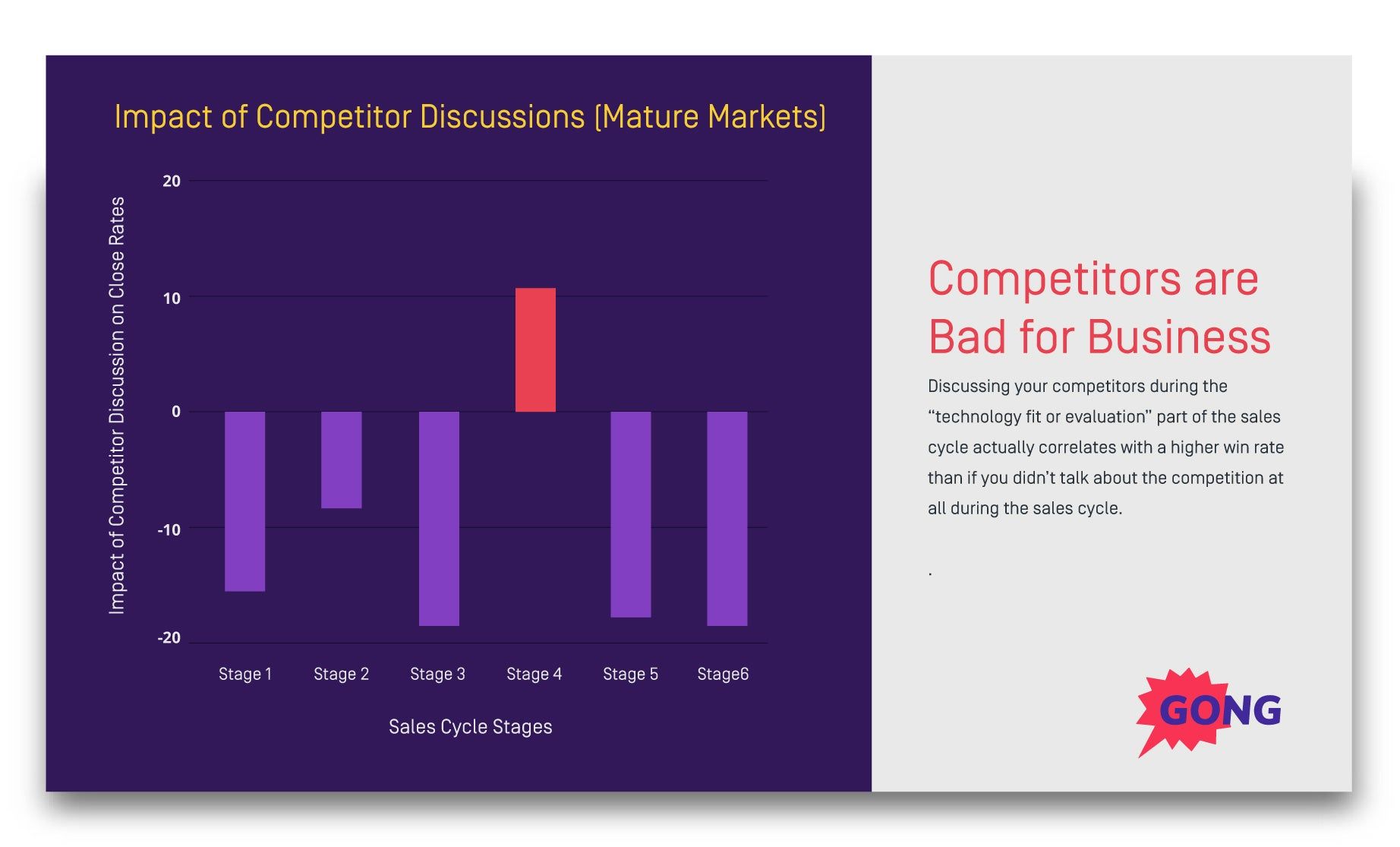
Prepare accordingly.Having a discussion about your competitors atanystage of the sales cyclereducesyour odds of winning the deal, compared to if competitors were completely absent from your deal.Except for one stage:Discussing your competitors during the technology fit or evaluation part of the sales cycle actually correlates with ahigherwin rate than if the deal was absent from competitor discussions.Every other stage correlates with alowerwin rate than if the deal was absent from competitor discussions.This tells us a few things.
Differentiation is Marketing’s Job In Mature Markets
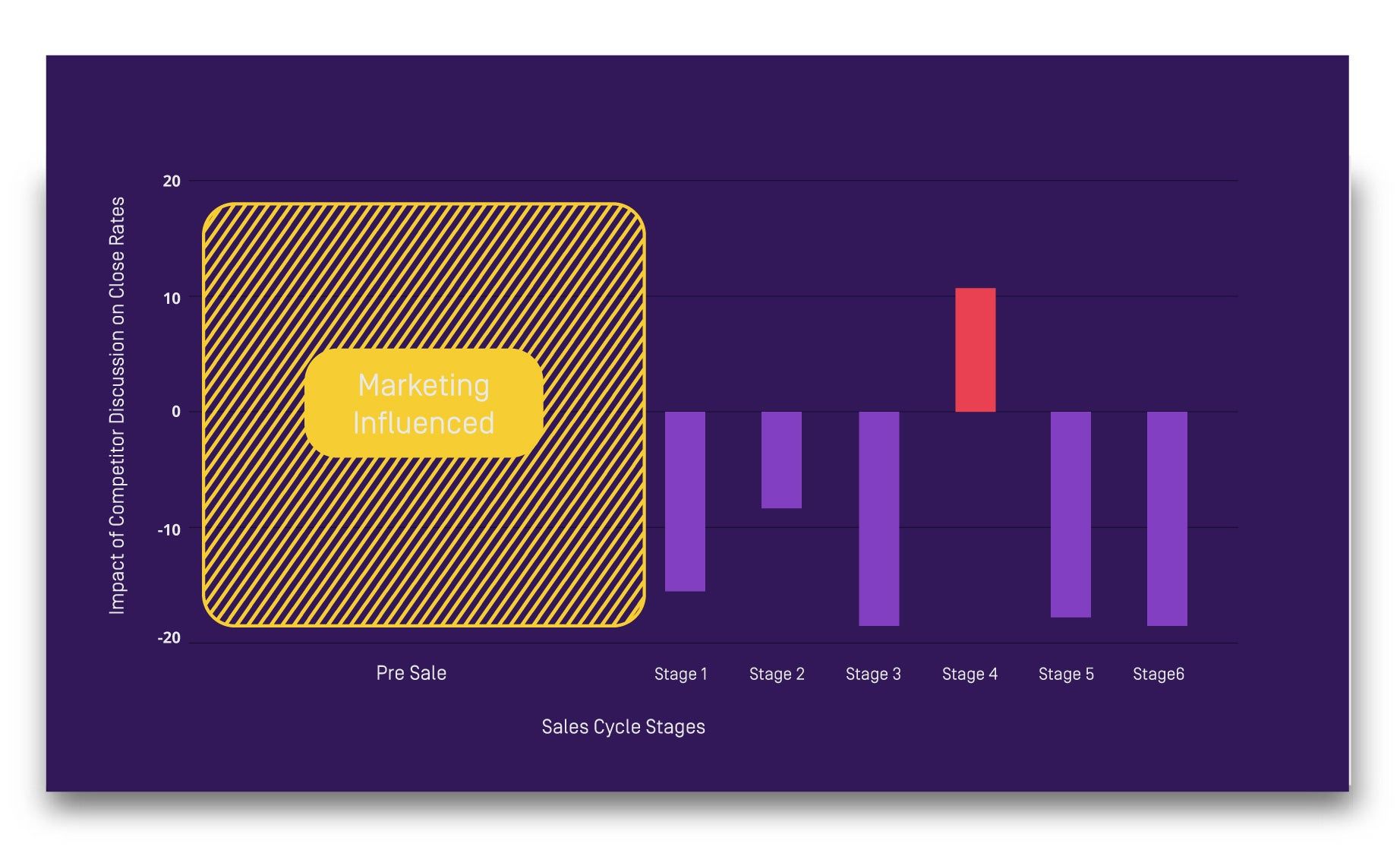
In mature markets,the burden of differentiation falls on marketing, not just sales.It’s marketing’s job topreempt the competitionbefore the buyer enters the sales cycle.Marketing must win that battle before it begins.Every marketing communication has to focus on ameaningfulanduniqueselling proposition.That way, buyers enter the sales cyclepreferring you.
You Have One Good Shot at Winning
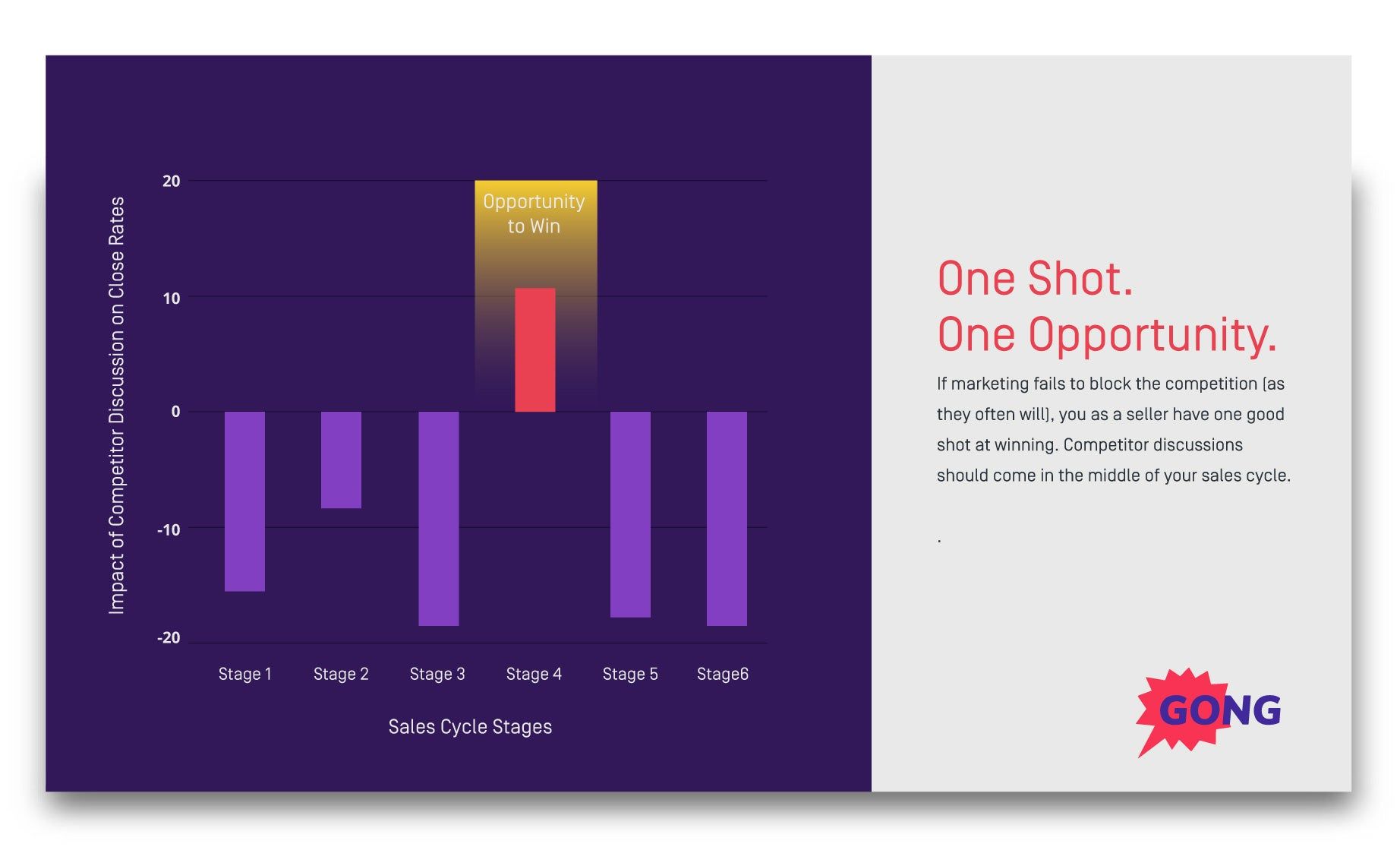
The second takeaway is that if marketing fails to preempt the competition (as they often will), you haveone good shotat winning.It happens in the middle of the sales cycle when the buyer takes a deep look at your technology with a scrutinizing eye:In mature markets all the products look identical to the untrained eye.That’s part of what makes mature markets so tough.You’re like the parent who’s able to tell the difference between their twin children with ease.It’s not so easy for everyone else.That includes your buyers evaluating multiple products that closely resemble each other.So when your buyer in effect says,“Hey, I’m paying attention. Help me tell the difference here,”you’better be armed with a powerful answer.If you are, they’ll reward you with their business.
Another Strategy That Wins In Mature Markets
There’s another strategy the top sellers use to win competitive deals in mature markets.I call it the “Clinger Strategy.”Top sellers identifyone thingtheir buyer values in their productoverthe competition.Then they talk about itfor the rest of the sales cycle,minimizing discussions that go outside of it (at least, during competitive conversations).Theyclingto that critical issue as if their life — or deal — depends on it.Let me explain.The AI we used for this analysis identified:
- Topicsdiscussed throughout the sales cycle
- How longthose topics were discussed
- Whenthey were discussed
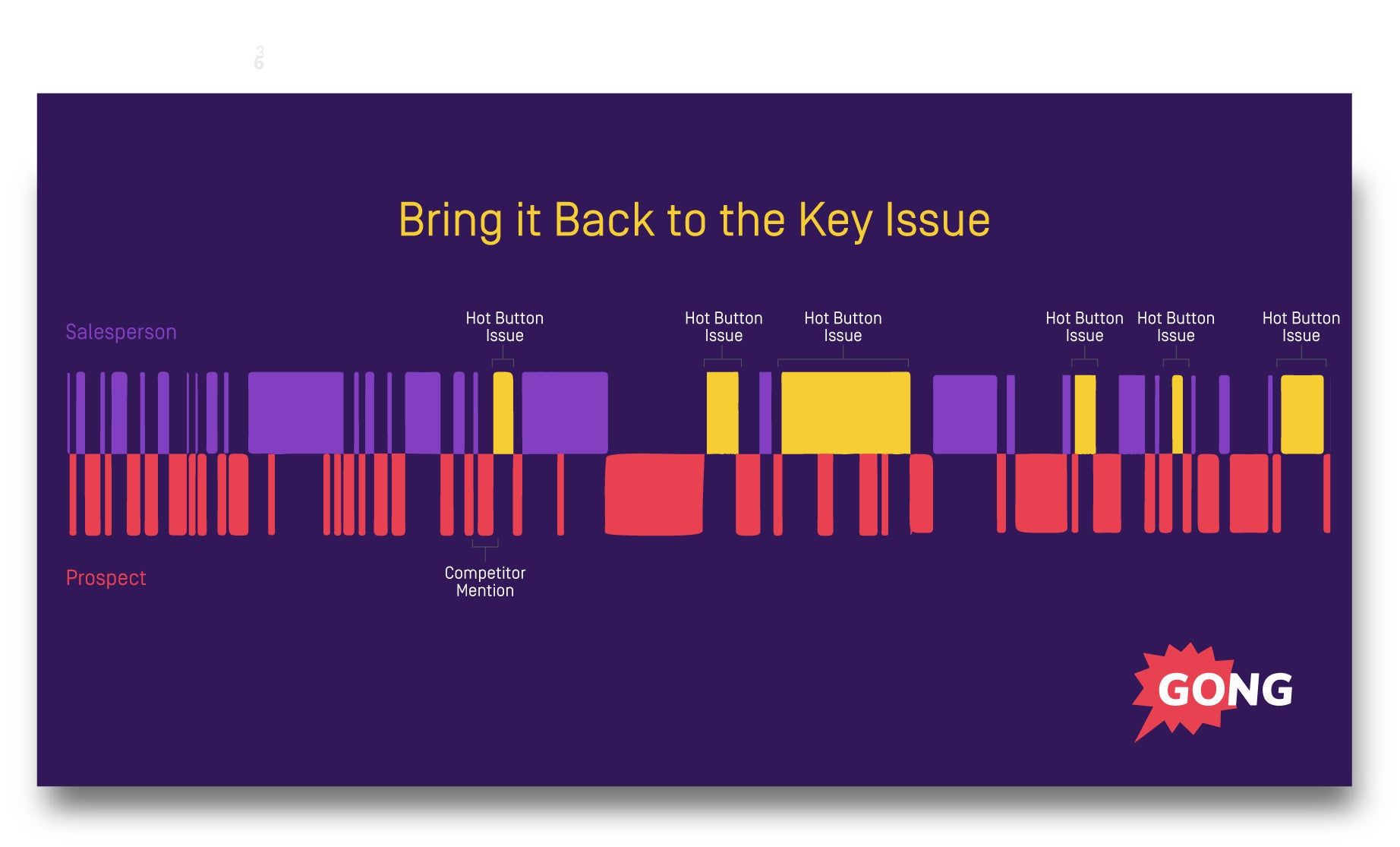
It turns out that top sellers test the waters the first time the competition comes up in the sales cycle.That’s when they discuss afewtopics around the competition.But, in subsequent competitor discussions, top sellerszero inon theonetopic that stood out as more important than the rest.They bring the buyer back to thathot-button issueover and overwhenever the competition comes up.It’s as if a mention of their competitorstriggersthem to revert to that one winning topic.By doing so, theycontinually reinforcefavorable buying criteria.By contrast, deals that are lost to competitors have no such pattern.Those competitor conversations arescattered, sporadic,anddiluted.Theirwinning differentiatorgets lost and they don’t gain an advantage in the conversation.Trying to win withtoo manydifferentiators waters down your message.When your buyer tries to recall how you’re different, they’ll be at a loss. There was so much being communicated that nothing stuck.Sticking withonethingplants it in their brain.
Selling Against the Competition inNewMarkets
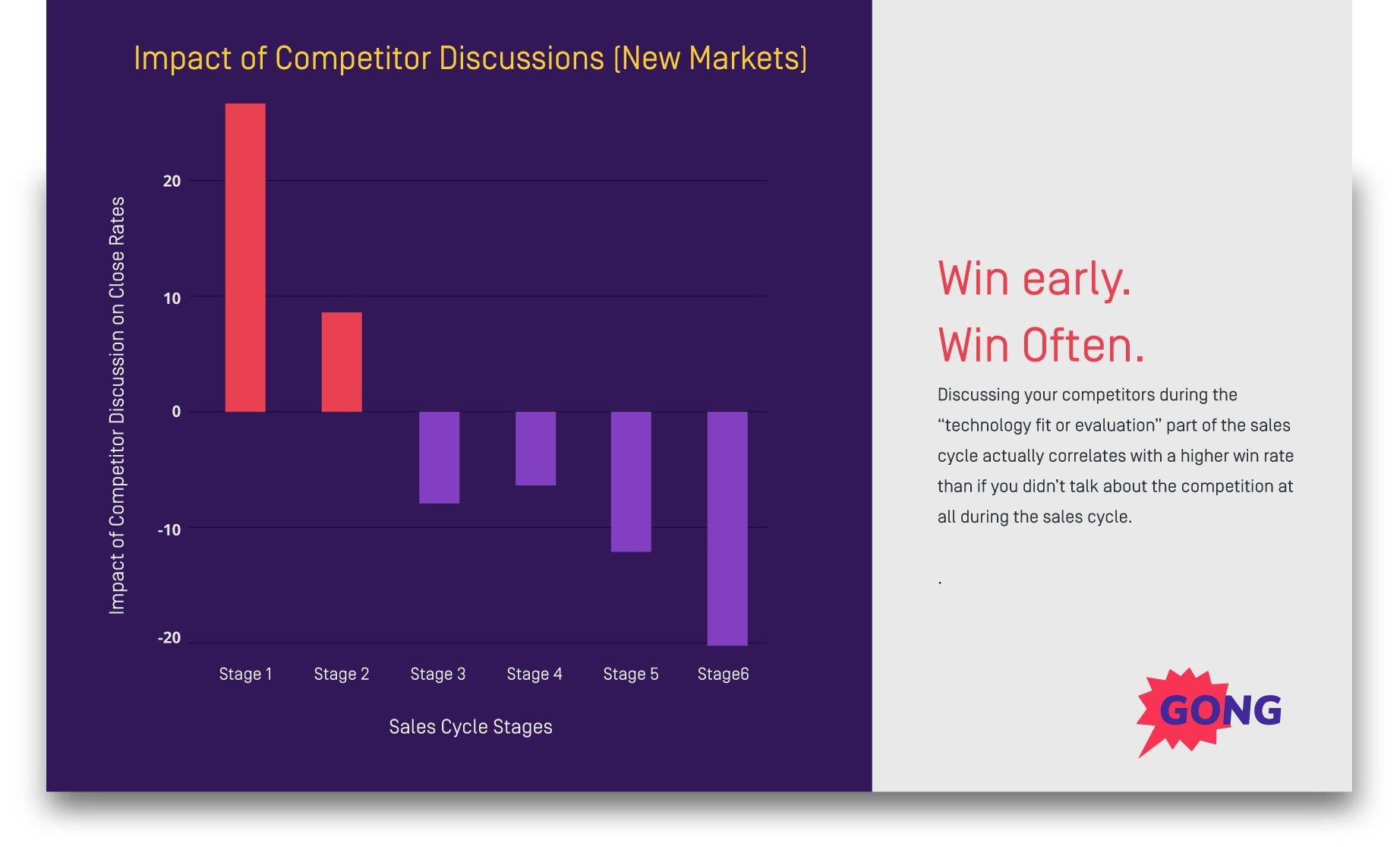
Selling in a new market is different in thatcompetitive deals are a good thing, provided you win the battle early in the sales cycle.Discussing your competitors at thebeginningof the sales cycle correlates with a24%higherlikelihood of closing the dealcompared to not discussing the competition at all.That said, your likelihood of closing a deal gradually diminishes when you discuss the competition at each subsequent stage of the sales cycle.That trend continues until the final stage of the sales cycle.By then, if you’re still having discussions about your competitors, you’re 20%less likely to struggle with your closing techniques than if your competitors were absent entirely.The takeaway?
Competitors in new markets aregood. BUT – you have to win the battle early on.
Buyers who enter the sales process with immediate questions about your competitors arebetterthan buyers that have no knowledge of your competitors.These buyers are educated.They’re “categoryaware.”They have a better understanding of the problem you solve, and have a high intent to buy.Even though youhatethat your competitors are in the game, it’s better than dealing with a buyer that’s never heard of you or your category.It’s your job is to crystallize their buying criteria in your favor early on, before it’s too late.Trying to change the trajectory of a deal late in the game is futile.As they say, an ounce of prevention is worth a pound of cure.
The Strategy for Winning In New Markets
There’s one word that defines how the bestsellers win competitive deals early on:
Positioning.
As Geoffrey Moore explained inCrossing the Chasm:
“Buyer evaluations are often simply rationalizations of pre-established positioning.”
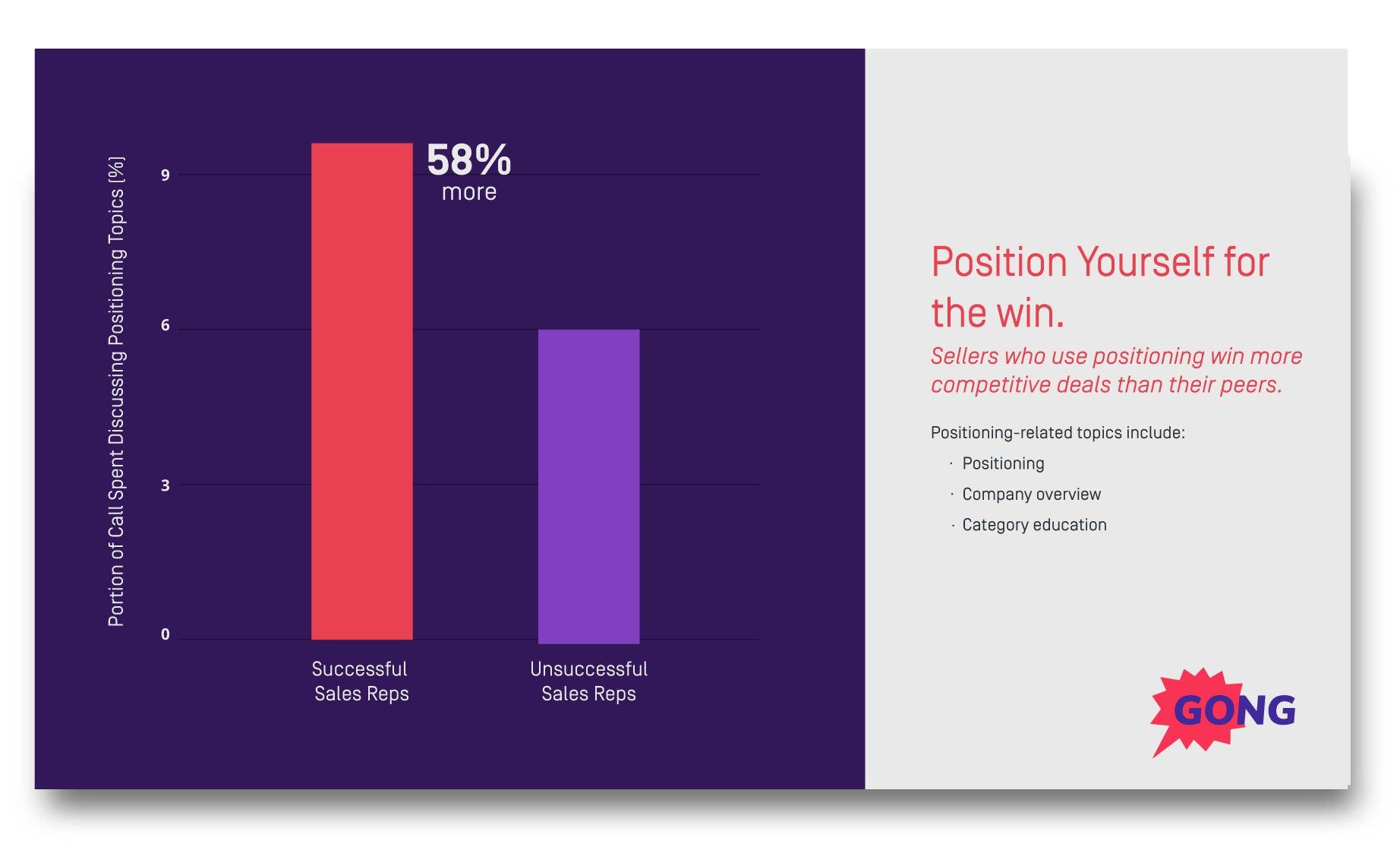
What does that mean?If you occupy the right position in your buyer’s mind, the rest of the game will unfold with ease.Even though this is also true in a mature market, the difference is that the burden ofpositioning in new markets falls on the seller’s shoulders, not just marketing.The market is not yet educated enough for your marketing team to realistically preempt every buyer that enters the sales cycle.So the positioning task must fall on you as the seller.Sellers who embrace positioning on sales calls win more competitive deals than their peers.When we analyzed the topics discussed in the early stages of competitive deals, we found that winning sellers covered positioning-related topics 58% more than their peers who eventuallylostthe deal:Positioning-related topics include:
- Positioning: Educate your buyer on the problem you solve and how you are uniquely positioned to handle their objections .
- Company overview: Explain your company, its background, and where it fits in with other similar companies.
- Category education: Walk your buyer through your market category and where you fit within it.
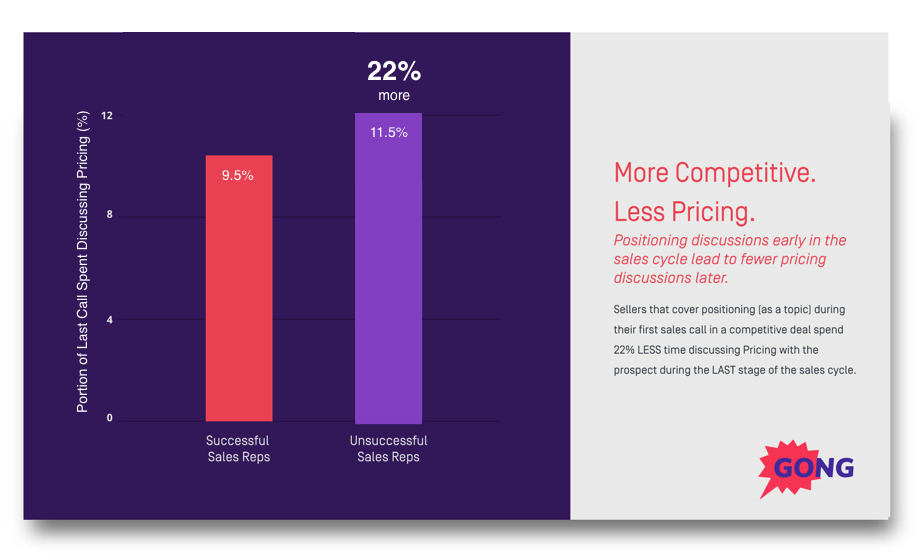
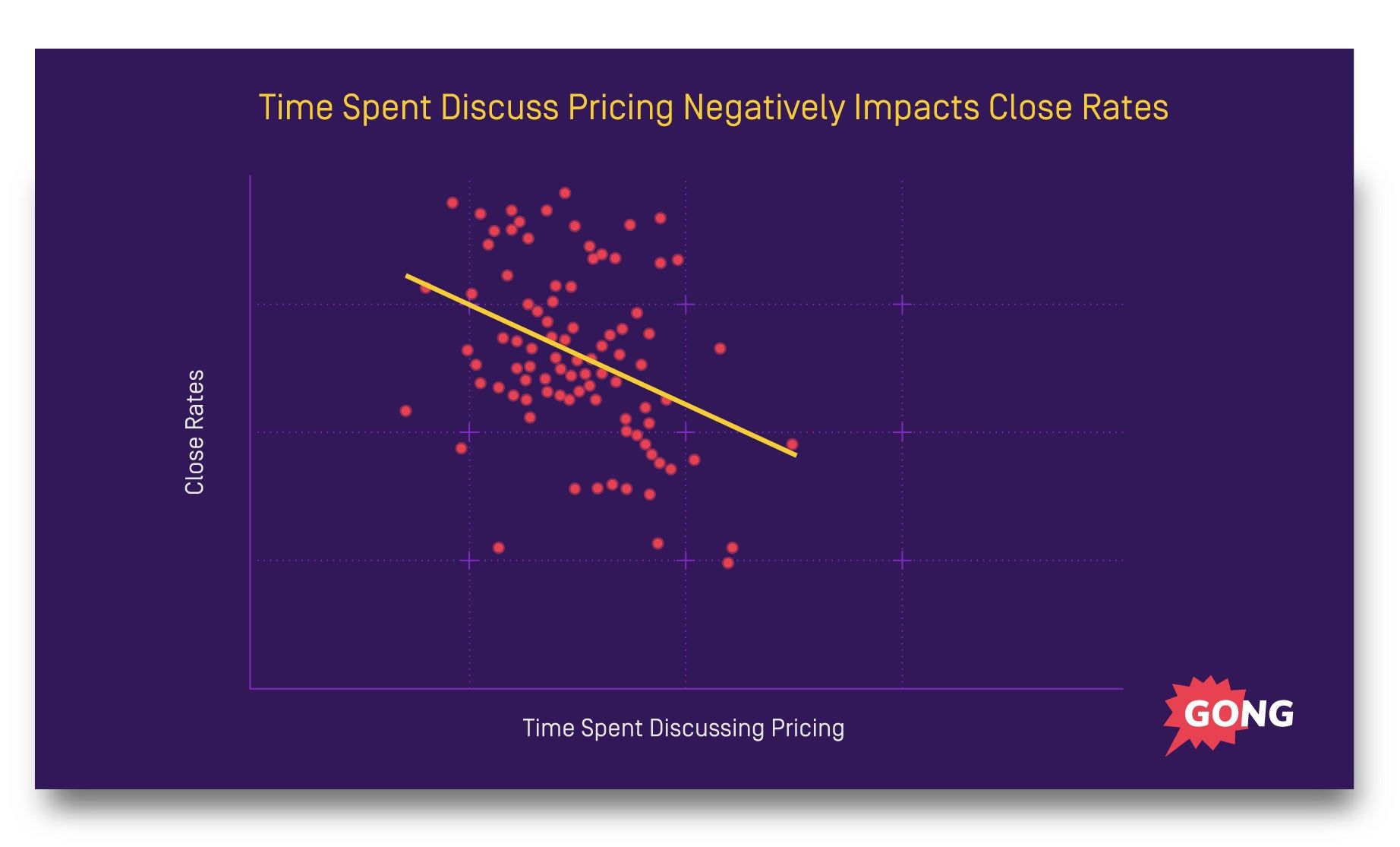
By educating buyers about the market, and cementing which part of it you occupy, you are more likely to avoid pricing wars at the end of the sales cycle:Avoiding this late-stage “race to the bottom” conversation is critical to you winning the deal.If it’s late in the game and the competition is still in the race, the longer you discuss pricing, the less likely you are to win:If you’re trying to win in the final hour, you would have been better off pre-empting the competition at the beginning of the sales cycle.Winning this late in the game can, of course, be done. But it’s beyond the scope of this article, and all I can do is wish you luck.
Download Our Printable Cheat Sheet


This article is not the last word on how to sell against the competition.But you can take the first step to winning more competitive deals by downloading a cheat sheet version of this post:Download it today, print it, and tape it to a wall near your sales team:Now it’s your turn.What’s in your bag of tricks?In the comments section below, tell us howyouwin against the competition.
Content Author
Chris Orlob is the Co-Founder and CEO of Pclub.io, a leading sales training platform designed to help sales professionals accelerate their revenue growth. He is best known for his pivotal role at Gong, where he helped scale the company from $200,000 to $200 million in ARR, contributing to a $7.2 billion valuation. During his tenure at Gong, Chris led the creation of Gong Labs and excelled in various go-to-market roles. Today, through Pclub.io, he leverages his deep expertise in sales and revenue operations to coach over 11,000 SaaS sellers.
Win more with Gong
Loading form...
Discover more from Gong
Check out the latest product information, executive insights, and selling tips and tricks, all on the Gong blog.