Home for the holidays: Data shows buyers check out sooner than you might think

Dan Morgese
Director, Content Strategy and Research at Gong
Published on: November 20, 2026

Every December, sales teams run the same play: push hard, chase signatures, and hope buyers stay at their desks long enough to close.
The data says that plan starts too late. Gong Labs analyzed sales meetings, conversations, and deal outcomes across the last two holiday seasons. The pattern was the same both years. Meetings vanish around Thanksgiving and Christmas, buyers and sellers start pushing decisions into next year as early as October, and the practical deadline for closing a deal arrives well before December 31.
The teams that finish plan around the work days that actually exist.
The real selling calendar is shorter than it looks
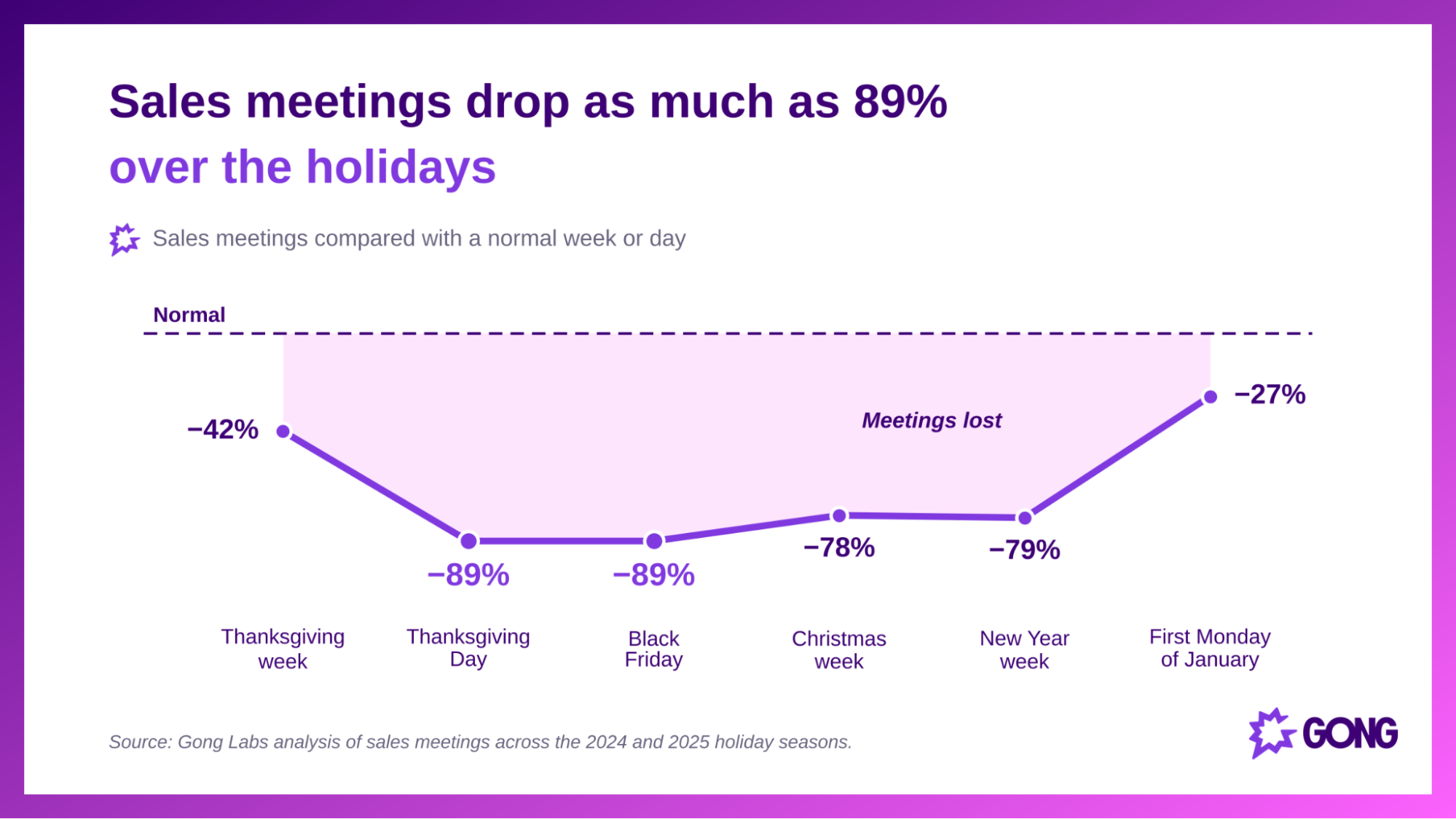
Thanksgiving week has 42% fewer sales meetings than a normal week. Both years agree: down 40% in one season and 43% in the other. Thanksgiving Day and Black Friday each lose 89% of their meetings.
This is a US effect. In the UK, meetings drop only 6% that week, and in Europe 7%.
Christmas week is quieter still, with 78% fewer meetings. That's the same figure Gong Labs found in 2021, so the pattern hasn't changed. New Year week is down 79%, and even the first Monday back in
All in, that's about two full weeks of normal meeting time that quietly disappears between late November and early January.
Deals close before the holiday break
The weeks right before each holiday are some of the busiest closing weeks of the year.
- The week before Christmas closes about as many new-business deals as the Q3 quarter-end week: 102% more than a normal week.
- The Wednesday before Thanksgiving closes 80% more deals than a normal day.
The holiday weeks themselves are another story. Thanksgiving week closes about 40% fewer deals than the October month-end week. In the UK, those two weeks close about the same number. Gong Labs found a similar dip in 2021 (27% fewer contracts), and the drop is now bigger.
The window also closes faster than most forecasts assume. Of the deals still open in mid-December, 6.7% were won by year-end. By Christmas week, that fell to 3.8%.
In other words, the real year-end deadline isn't December 31. It's the last few working days before each break.
“Let’s revisit in January” actually starts in October
The slowdown starts earlier than you might expect.
Gong Labs tracked phrases like “in the new year,” “after the holidays,” and “next year’s budget.” In mid-September, they showed up in 8.4% of calls. By the week of December 15, they were in nearly half.
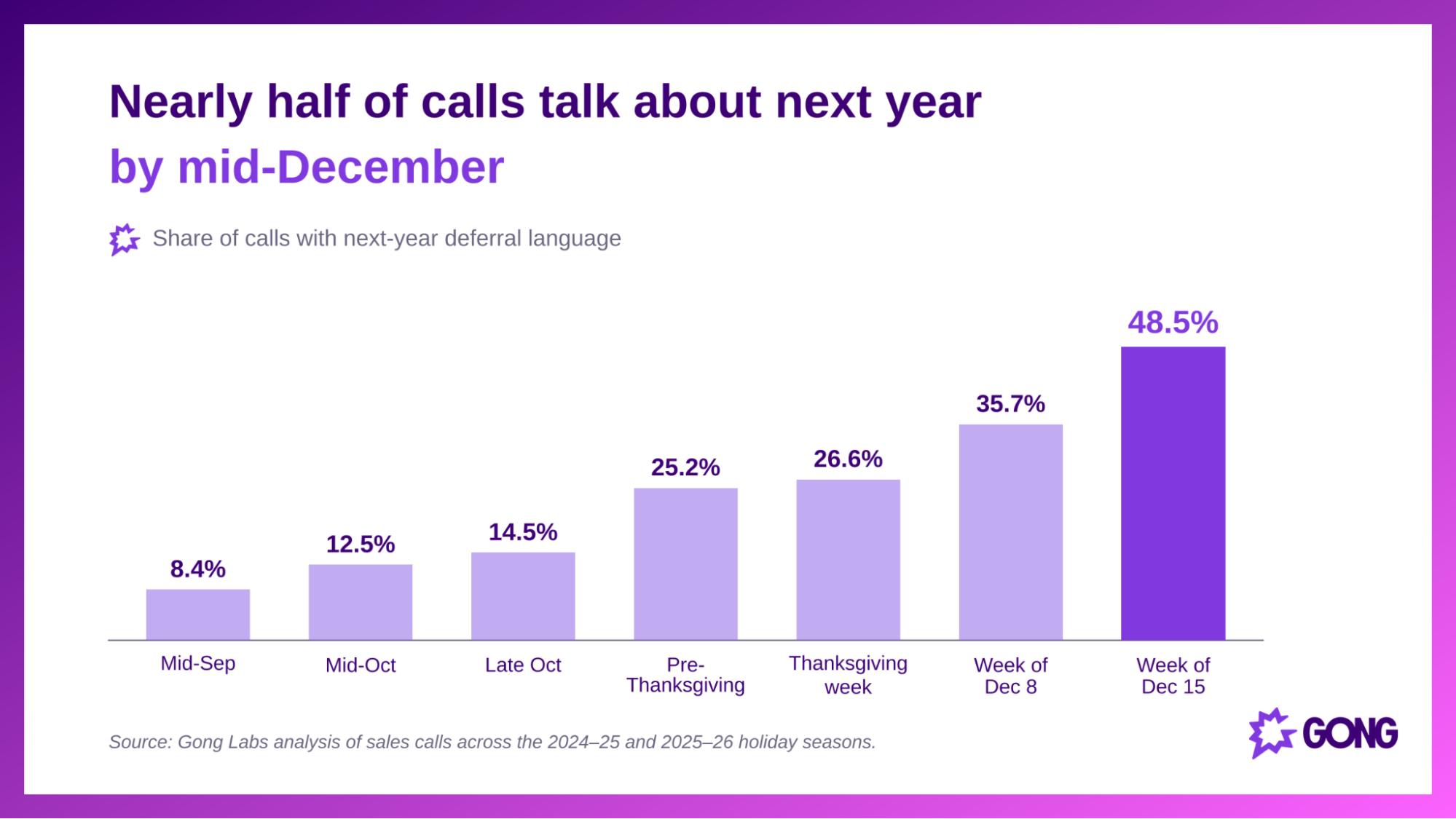
The two biggest jumps came the week before Thanksgiving and the week of December 15, when deferral language rose from 35.7% to 48.5% of calls in a single week.
And buyers aren't the only ones bringing up January. In mid-September, sellers and buyers used deferral language at about the same rate, roughly 4% of calls each. By the week of December 15, sellers used it in 35.6% of calls, vs. 24.9% for buyers. That doesn't prove sellers suggest the delay first. But it does show they're active participants in pushing deals into next year.
Momentum fades as the holidays get closer
Even when meetings happen, they're harder to keep moving.
Follow-up slows. During the week of December 8, 56.2% of calls had another call recorded within 14 days. The next week, that dropped to 45.8%. That two-week window runs straight into the holidays, so it reflects scheduling as much as interest. But the effect is the same: deals stall.
No-shows creep up, then jump. The same reps get stood up about 10% more often as usual from Thanksgiving through mid-December, and 36% more often during Christmas week. Only Christmas Day (2.7x) and New Year’s Day (2x) double the normal rate, and very few meetings are booked on those days anyway.
As you’re aligning calendars, remember that a meeting scheduled in late December is less likely to happen and less likely to lead to the next one.
In the UK, the squeeze comes later and hits harder
While UK sellers don't get a Thanksgiving slowdown, they do experience a steeper December.
Next-year talk in the US levels off after Thanksgiving. In the UK, it keeps climbing: 40% of calls the week of December 1, 50% the week of December 8 and 65% the week of December 15.
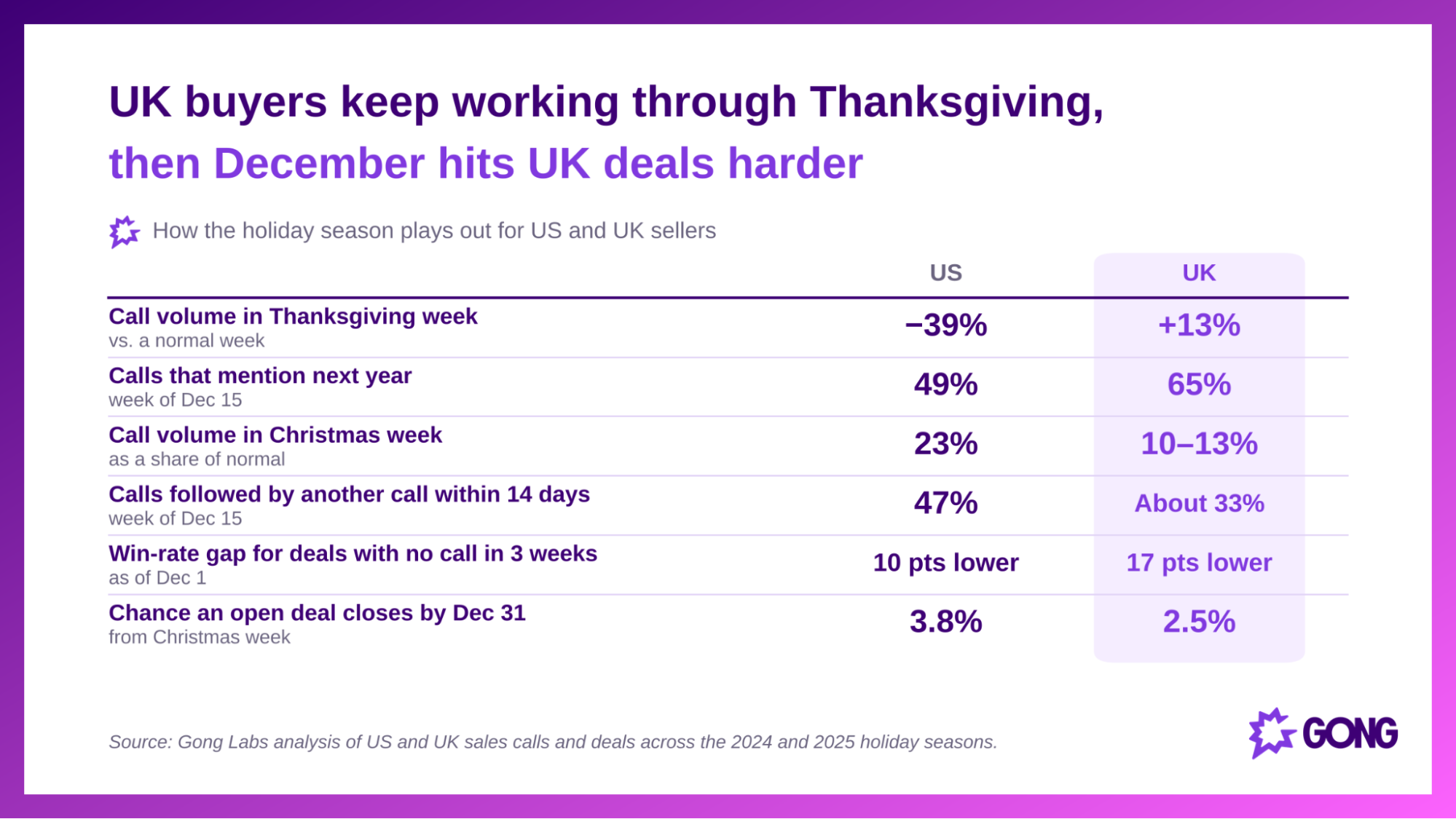
New Year week in the UK is close to silent, and the first week of January stays slow. For UK teams, the lesson is the same as in the US, only more urgent: the effective year-end comes in mid-December, and going quiet costs even more.
How to make every working day count
The holidays aren’t a surprise. The teams that finish the year strong treat them like a deadline they can plan around.
That starts before Thanksgiving. Have the timing conversation now: confirm the decision date, who signs and who’s out when, and aim signatures at the year’s two strongest closing windows, the Wednesday before Thanksgiving (November 25) and the week before Christmas (December 14 to 18).
Through December, the job is keeping deals from going quiet. Confirm meetings the day before, as no-shows are climbing; don’t be the first to suggest January; and if a deal does slip, book a specific first meeting for the new year before anyone leaves.
Then plan for a slow restart, since meetings are still down 27% on the first Monday back.
The selling year ends before the calendar year does. Plan accordingly and finish 2026 strong.
Director, Content Strategy and Research at Gong
For over a decade, Dan has provided revenue leaders with data and insights to inform and execute their GTM strategies. As a former analyst at Forrester Research, he worked with hundreds of B2B organizations to measure and improve sales productivity.
Discover more from Gong
Check out the latest product information, executive insights, and selling tips and tricks, all on the Gong blog.