The rise — and fall — of the em dash

Dan Morgese
Director, Content Strategy and Research at Gong
Published on: October 23, 2026

When ChatGPT launched in November 2022, revenue teams were some of the first to put it to work. Within months, sellers were using LLMs to research accounts, prep for calls and write emails faster than ever. Today, AI is part of almost every step of the sales process.
The benefits are real. But they came with a side effect: AI slop. Polished, generic messages that sound like they could have been sent to anyone, because they often were.
One of the easiest ways to spot AI slop is a small piece of punctuation: the em dash.
And let’s be honest. Unless you were a novelist, a journalist or a serious writer, you probably rarely used one.
AI models, on the other hand, use them constantly. So when em dashes started showing up everywhere in sales emails, buyers noticed.
Gong Labs analyzed 27.4 million English emails sent through Gong between November 2023 and September 2026 to see what happened. The em dash had a remarkable rise, a fast fall, and a measurable effect on whether buyers respond.
How the em dash took over
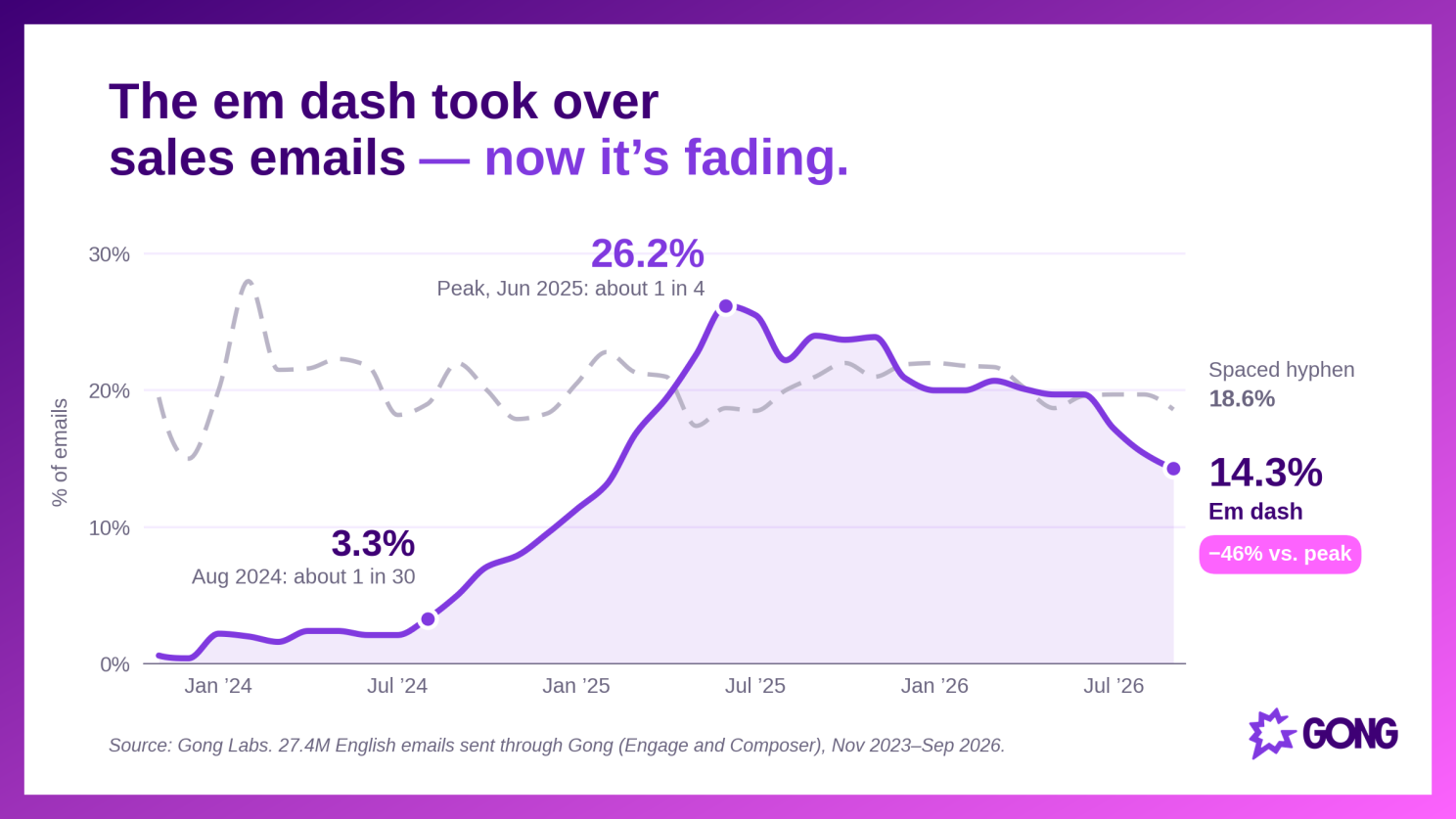
In August 2024, about 1 in 30 sales emails contained at least one em dash (3.3%). By June 2025, it was about 1 in 4 (26.2%).
That's an eightfold increase in ten months. Sellers didn't collectively fall in love with punctuation. The timing tracks with the spread of AI writing tools, and AI models are famously fond of the em dash.
Then buyers caught on
As AI-written outreach filled inboxes, the em dash picked up a reputation. It became one of the most talked-about signs that an email was written by AI rather than a person.
Sellers noticed. Since the June 2025 peak, the use of em dashes in sales emails has dropped 46%, to 14.3% of emails in September 2026.
The decline is specific to the em dash. The spaced hyphen, the more casual cousin many people type instead, has stayed fairly steady at around 19% to 22% of emails for most of the period, ending at 18.6%. People didn't stop using dashes. They stopped using the one that gives them away.
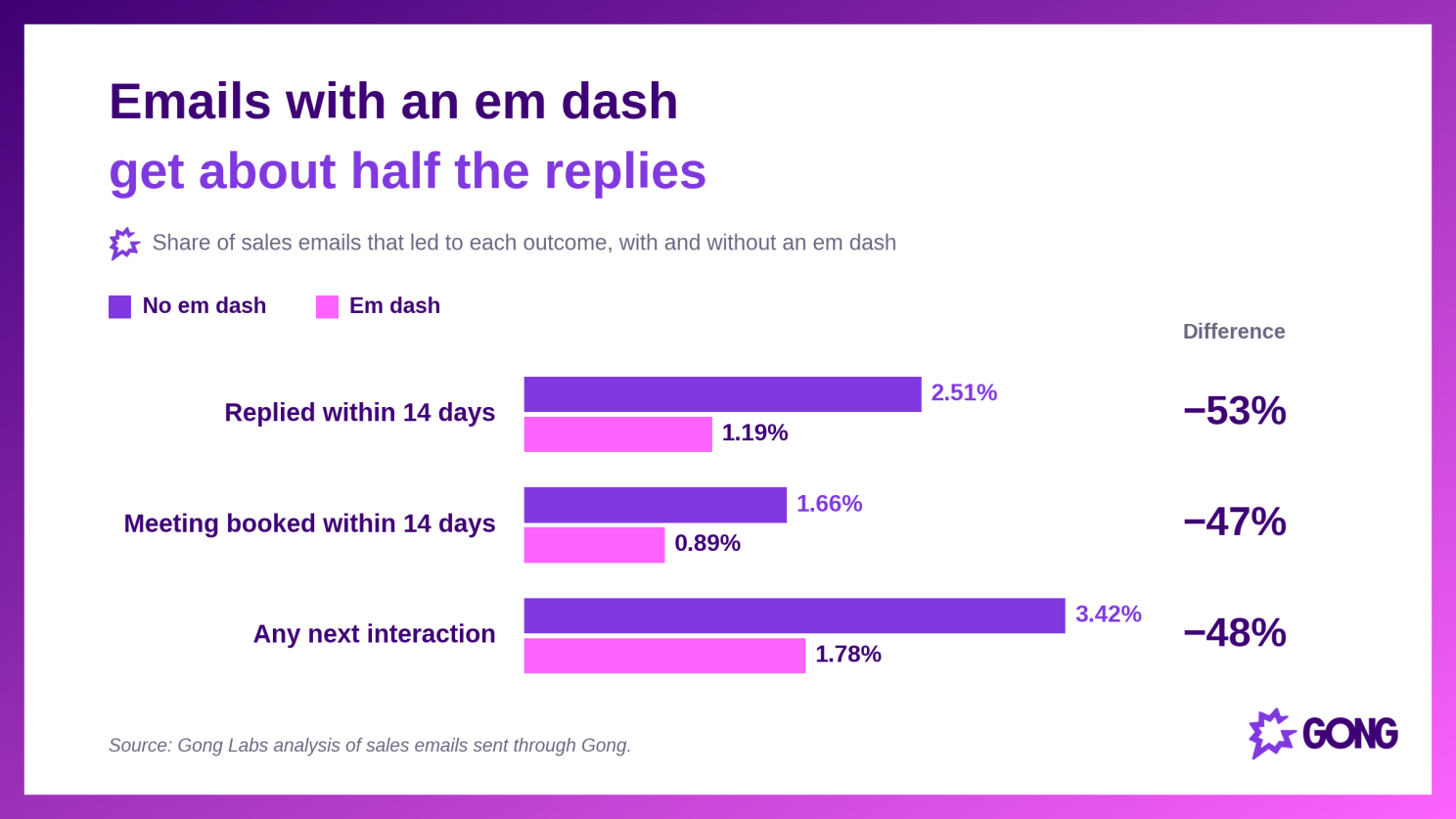
Emails with em dashes get about half the replies
The bigger question for sellers is whether it matters.
It does.
Across all sales emails in the dataset, those with an em dash performed far worse than those without one.
Emails with an em dash were about half as likely to get a reply, book a meeting, or lead to any next interaction.
Is it the dash, or what it signals?
It's almost certainly not the punctuation itself. No buyer ignores an email because of one character.
What the em dash likely signals is everything that tends to come with it: an email drafted by AI and sent without much editing. Those emails often share the same structure, the same polished but generic phrasing, and the same lack of anything specific to the buyer. The em dash is just the easiest part to spot.
This is also a straight comparison of emails with and without an em dash, not a controlled experiment. The difference could reflect other factors, like who is sending these emails or how many go out at once. But the pattern lines up with what sellers and buyers have been saying for the past year: outreach that sounds like AI gets treated like AI.
Which means deleting the em dashes from an AI draft won't fix much. The dash is the symptom. Sounding like everyone else is the problem.
What this means for sellers
Use AI for the work, not the voice. AI is great at research, finding a trigger worth reaching out on, and giving you a first structure. The final email should sound like you wrote it, because you did.
Read it out loud. If a sentence sounds like something you'd never say on a call, rewrite it. That catches far more than punctuation.
Make it specific. The best defense against sounding generic is saying something only you could say to this buyer: a detail about their business, a relevant result, a real reason you're reaching out now.
Leaders: coach the tone, not just the volume. AI makes it easy to send more emails. Reviewing how those emails actually sound is what keeps your team's outreach from blending into everyone else's.
Methodology
Gong Labs analyzed 27.4 million English emails sent through Gong between November 2023 and September 2026. An email counts as using an em dash if it contains at least one em dash character (—). Outcomes compare all sales emails with and without an em dash, without controls for sender, company or other factors. Reply and meeting outcomes are measured within 14 days of sending.
This article is part of the Gong Labs series, where we publish findings from our data research team. We analyze sales conversations and deals using Gong Revenue AI, then use the results to help you win more deals. Subscribe here to read upcoming research.
For the record, this article uses exactly two em dashes. Both are in the headline.
Director, Content Strategy and Research at Gong
For over a decade, Dan has provided revenue leaders with data and insights to inform and execute their GTM strategies. As a former analyst at Forrester Research, he worked with hundreds of B2B organizations to measure and improve sales productivity.
Win more with Gong
Loading form...
Discover more from Gong
Check out the latest product information, executive insights, and selling tips and tricks, all on the Gong blog.