Sales strategies
Mastering winning sales conversations

Chris Orlob
Content Author
Published on: April 10, 2017
In the Gong Research Labs series, we publish data from analyzing sales calls with natural language processing and AI. Subscribe here for new data every week.
. . .
Key Components of Winning Conversations
Every word and phrase uttered on a B2B sales call influences the outcome of that deal. Sales conversations are what drive revenue. But until now, they’ve been guesswork.
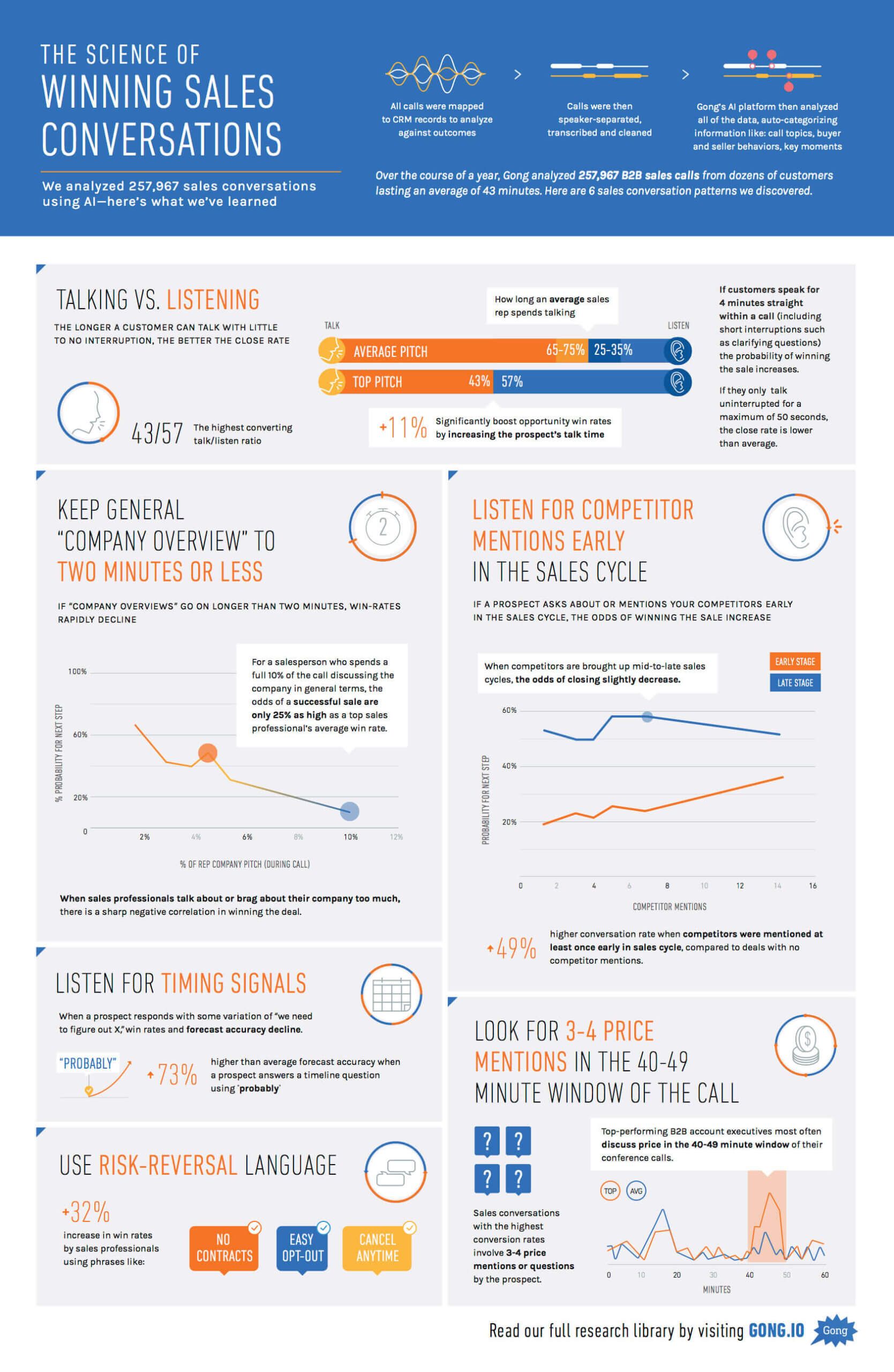
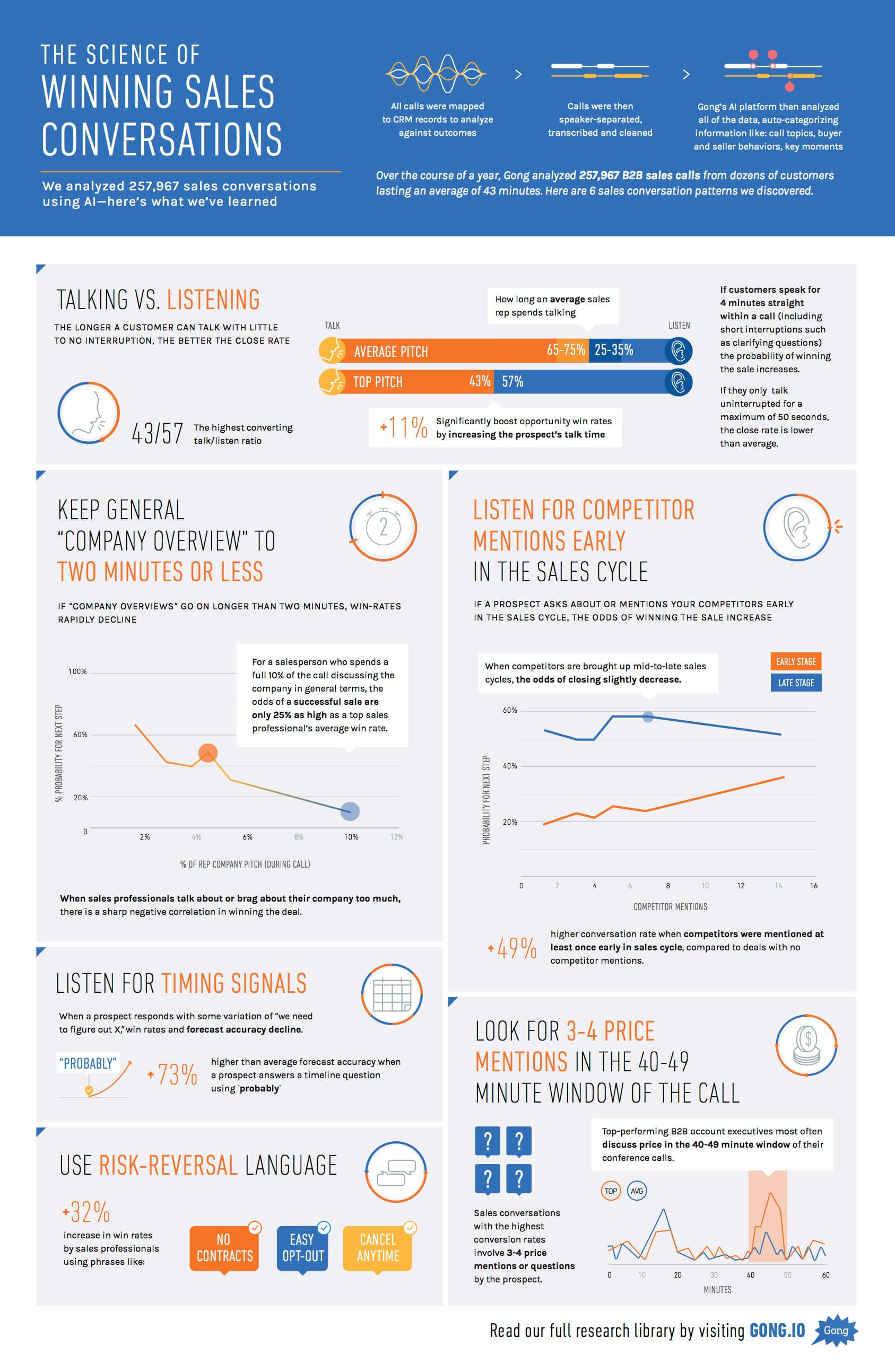
Hundreds of thousands of sales call recordings were fed through Gong’s self-learning conversation analytics engine to surface the patterns of what top sales performers do on their sales calls. Check out the infographic below to see how your sales conversations stack up.
(Click to Enlarge)
Talking vs. Listening: The highest performing B2B sales conversations have a 43:57 talk-to-listen ratio. And the longer you can get your customer talking for an uninterrupted period of time, the better.
Company Overviews: Keep the “About Us” part of your sales deck to a minimum. Two minutes spent on this seems to be fine. After that, there is a sharp dropoff in win-rates.
Competitor Mentions: When your competitors are mentioned early in the sales cycle, you have a greater chance of winning the deal than if they were not mentioned at all. However, if they were mentioned late in the game, your win rates will be lower on average.
Listen for Timing Signals: It turns out, there are specific linguistic cues buyers will signal during sales conversations that indicate their likelihood of purchase. For example, when you ask the “timing question,” look for the word probably in their response (a good thing), as well as the phrase “we need to figure out ________” (a negative signal).
Risk-Reversal Language: When sales professionals use risk-soothing language with their buyers, such as talking about opt-outs, guarantees, and SLAs, they increase their sales win rates by 32% on average.
Pricing Trends: Top B2B sales reps “talk price” in the 40-49 minute on their sales calls (whereas average and low performers tend to distribute their pricing discussions evenly throughout the call). We also discovered that 3-4 pricing questions or mentions by the buyer correlate with the highest win rates. Less than three or more than four, and win-rates begin declining.
If you liked this article you may also be interested in:
- Demo to Win – Increase your organization’s Demo-to-Close Conversion rate
- Increase sales win rates – How to Increase Sales Win-Rates By 32% Using “Risk-Reversal Language”
- Talk vs Listen Ratio – The Highest Converting Talk-to-Listen Ratio in Sales, Based on 25,537 Sales Calls
Content Author
Chris Orlob is the Co-Founder and CEO of Pclub.io, a leading sales training platform designed to help sales professionals accelerate their revenue growth. He is best known for his pivotal role at Gong, where he helped scale the company from $200,000 to $200 million in ARR, contributing to a $7.2 billion valuation. During his tenure at Gong, Chris led the creation of Gong Labs and excelled in various go-to-market roles. Today, through Pclub.io, he leverages his deep expertise in sales and revenue operations to coach over 11,000 SaaS sellers.
Win more with Gong
Loading form...
Discover more from Gong
Check out the latest product information, executive insights, and selling tips and tricks, all on the Gong blog.