Sales strategies
The Secret Formula for Productive Remote One-On-Ones

Jonathan Costet
Content Author
Published on: April 29, 2020
Last modified on: March 4, 2026
Some one-on-ones areso goodthat you walk out feeling motivated for the whole week.
Others, not so much.
We asked sales managers their secrets for running remote one-on-ones that leave reps cravingmore.
The kind that deserve a hand-stinging, ear-ringing high five (exceptnot right nowbecause, you know, social-distancing).
Put these 6 elements together to turn your one-on-ones into a pure shot of motivation and boost team productivity.
Tip #1: Review A Recorded Sales Call
We all know it’s impossible to revieweverycall oneveryone-on-one.
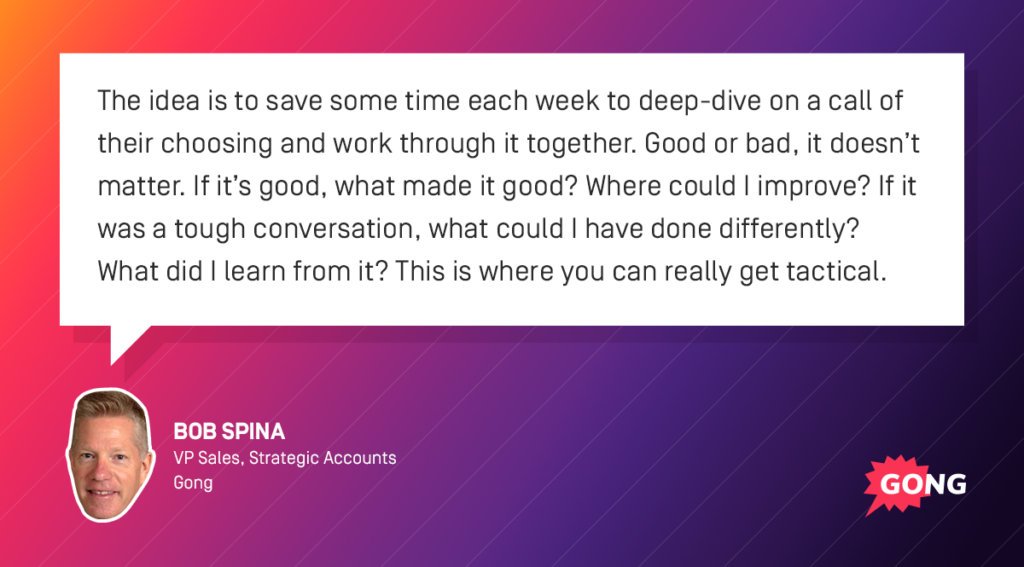
Most sales managers attempt to review a few calls during a one-on-one. Gong’s VP Sales and Strategic Accounts, Bob Spina, suggests reps come to the meeting with one call.
That’s right. Just one.
It doesn’t have to be the best call of their life (or the worst, for that matter).
Maybe it left them scratching their head. Maybe it caught them off guard. Maybe it confirmed something they’ve thought for a while.
In short, there is no “right” or “best” call to bring to a one-on-one — the key is that it’s just one.
The Goal: Analyze it. Understand what went well. And think about ways to improve. Find out more here .
Tip #2: Use A Consistent Meeting Structure
ABC – Always. Be. Consistent.
One thing we need in our lives — especially in our current work/life situation — is a routine, something regular, something we can expect.
When it comes to running remote one-on-one meetings with sales reps, consistency is critical.
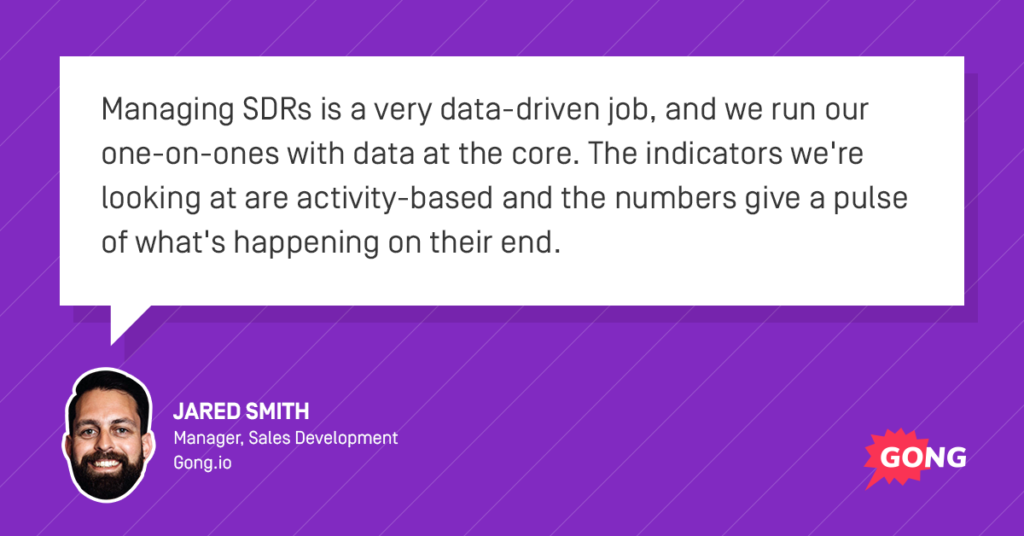
Gong’s Sales Development Manager, Jared Smith, is a huge advocate for structuring every meeting around the same 3 questions:
- How did things go last week?
- Did we accomplish our goal(s)?
- What solutions can we find for next week?
The first questionis intentionally open-ended. It’s meant to check the pulse both from a businessanda mental perspective. It also helps get the ball rolling by motivating reps to what’s top of mind for them entering their one-on-one meeting.
The second questionkeeps everyone accountable. There is no sense in creating goals if we don’t at leasttryto achieve them. But, let’s be realistic, not every goal will be met every week. If so, the bar isn’t high enough. This is where coaching comes in. If the goal was not met, ask, “What barriers prevented you from accomplishing your goal?”
The third questionbuilds on the second: “What solutions can we find for next week?” Followed by, “How can I help ensure you reach future goals?”
Pick your set of one-on-one questions. Rinse and repeat.
Want more one-on-one questions that aren’t “What’s going to close this month”?
We’ve got you covered with our Sales 1:1 Template .
It’s got everything you need to start running uber-successful 1:1s.

Tip #3: Focus On Strategy
Review key deals before stepping (or, you know, dialing), into your next one-one-one.
That means looking at recent activity, stakeholders on both sides of the deal, as well as call notes or recordings.
This way, your meeting is teed up to focus on the most important part of any one-on-one:strategy.
This is where great one-on-ones really pick up steam. And where others fall into the anecdotal trap.
Start looking at accounts and thinking creatively about next-best-steps for each of them.
Sending out an agenda ahead of time lets your rep review items, add to the list, and start thinking about how they are going to reply.
Remember:yourpreparation helps withtheirpreparation, which leads to a more effective remote one-on-one.
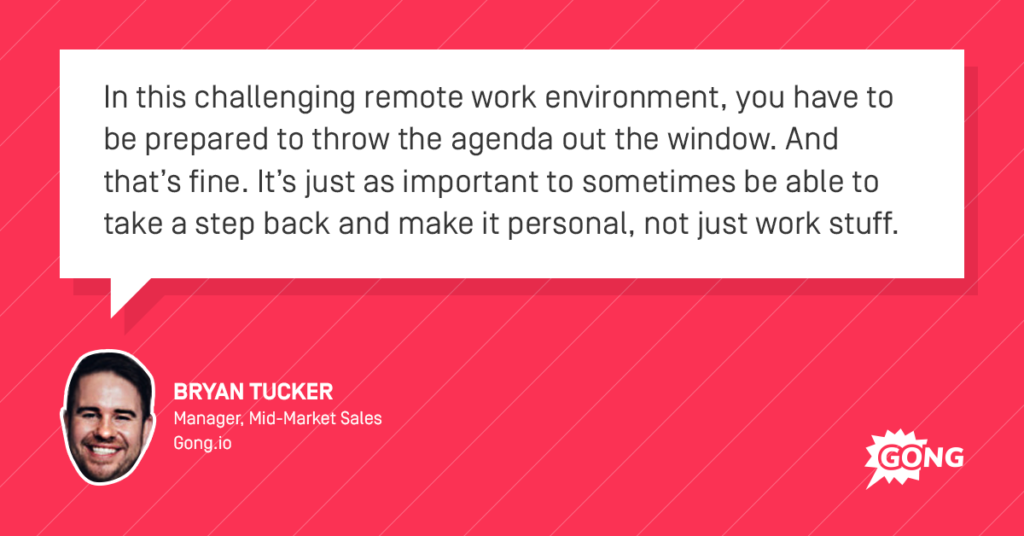
HOWEVER, as Tucker points out, work from homecanthrow the occasional curveball.
Tip #4: Motivate And Drive Change Management
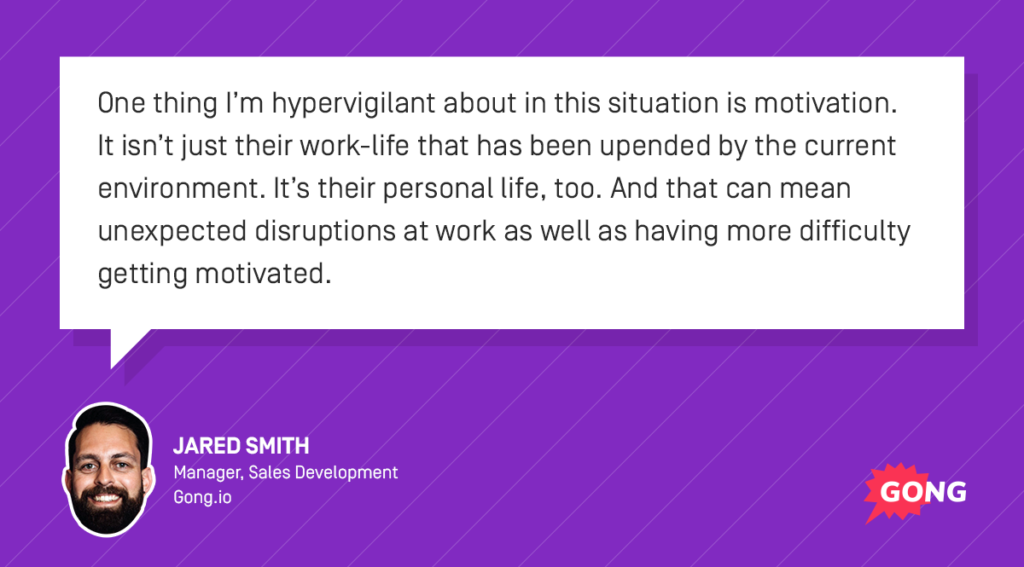
Making time to check motivation — especially during “shelter-in-place-work-from-home” — is critical.
It’s also an opportunity to connect with reps in a more personal way.
Sure, while in the office informal “drive-by” meetings happen naturally during the week.
But now that these aren’t happening anymore, it’s important for one-on-ones to make up for lost facetime.
And if your meetings are running a tad on the long side, don’t sweat it. Motivation check-ups are paramount to building a successful relationship and team chemistry.
Gotta have each other’s back out there, amiright?
Tip #5: Follow The Numbers
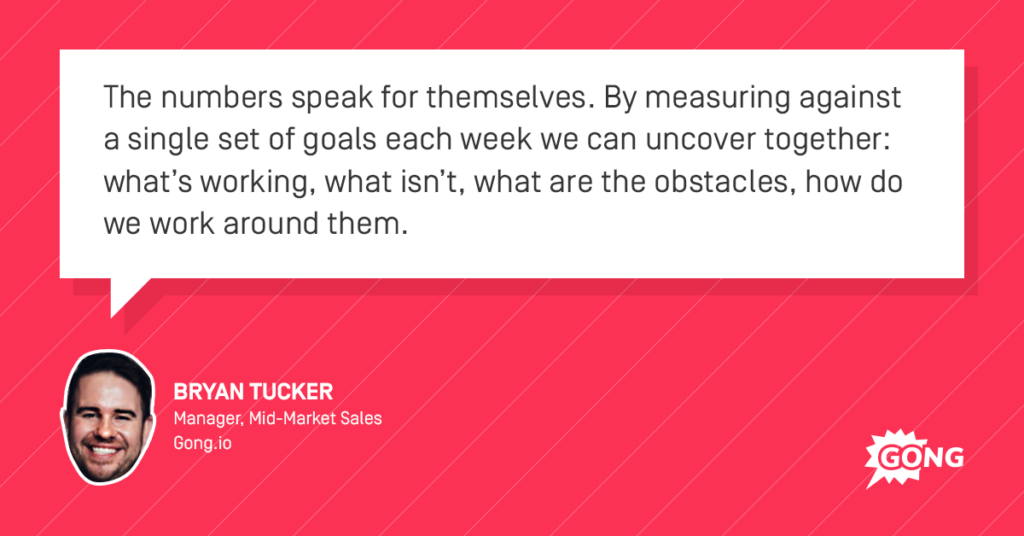
Bryan Tucker suggests tracking the same 2-3 KPIs during every one-on-one.
This ensures focus, and focus leads to results.
From a manager’s point of view, these KPIs drive the conversation and must be addressed every single meeting.
From a reps point of view, they offer clarity into what’s expected of them (beyond quota attainment).
That way, managers can zoom into particular areas of improvement for a rep, like improving top of funnel conversion rates. And come up with a plan to get that metric where it needs to be: like adding 2 accounts into pilot WoW.
It also let reps measure their performance on shorter cycles than, say, a quarter or a fiscal year.
Talk about these goals and measure progress against them.
We have some suggestions if you need inspiration,but true development comes from a custom game plan.Some might need to focus on activity while others on more strategic KPIs:
For SDRs:
- Activity: Calls/emails made
- Quality: Response rate
- Impact: Opportunities created
For sales reps:
- Activity: Calls/emails made
- Quality: Conversion rate, # of DMs in calls
- Impact: Pipeline generated
These should be easy to access (provided you use sales analytics software ).
Tip #6: Ask Questions, Give Answers
As managers, we aska lotof questions. Like “why do you think this happened?” or “What do you think was the reason?”
These are great questions.
Open-ended.
And they force reps to think.
However, reps also wantyouto suggest ideas.
In one-on-one meetings, they evenexpectit. Don’t leave them hanging.
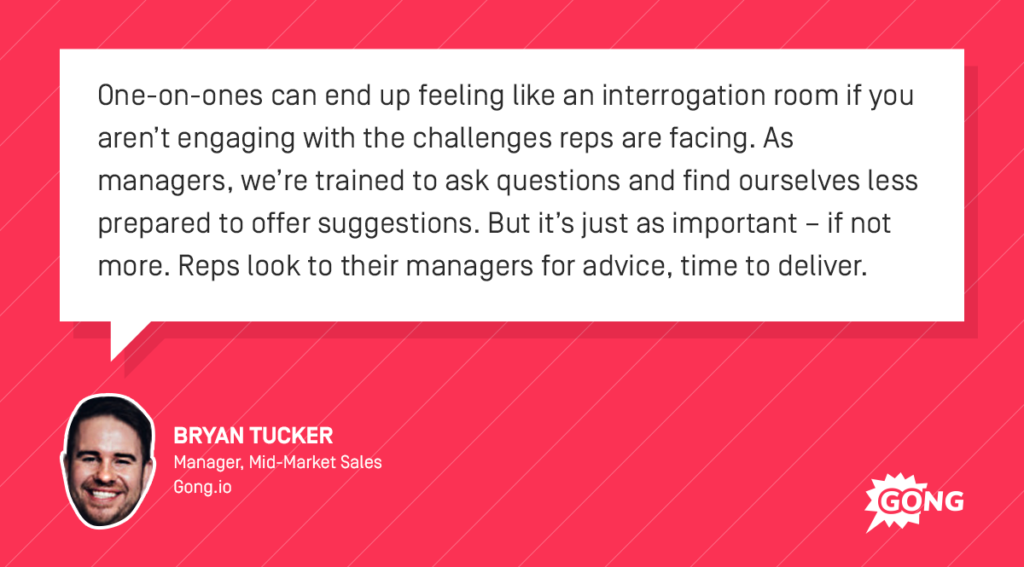
Next time you’re asked what you would do, don’t deflect: get your hands dirty and come up with a plan together.
Your reps will thank you for it.
Take Your Coaching Superpowers To The Next Level
These questions seem harmless.
But if you’re using your 1:1s to ask:Who have you talked to? What did you talk about? What’s the next step?
That’s not coaching.
That’s just updating CRM. Out loud. To each other.
Very anti-coaching.
Very un-you.
This is how you cut the game of catch-up and skip to the good stuff:
Use this all-thrills no-frills sales 1:1 template for uber-successful 1:1s.
You’re one click away from setting your team on an un-stop-pa-ble winning streak.
Content Author
Jonathan Costet is the Senior Director of Revenue Marketing at Wiz. Before this, he was Senior Manager, Growth Marketing at Gong, where he played a crucial role in driving demand generation through data-driven strategies. At Gong, Jonathan harnessed the power of revenue intelligence to craft effective messaging, improve customer retention, and optimize sales forecasting. He was instrumental in using Gong's platform to unlock insights that helped target the right buyers and maximize marketing efficiency.
Win more with Gong
Loading form...
Discover more from Gong
Check out the latest product information, executive insights, and selling tips and tricks, all on the Gong blog.