Executive insights
Do execs really reply to cold email? Here’s what the data says

Dan Morgese
Director, Content Strategy and Research at Gong
Published on: January 29, 2026
Last modified on: May 27, 2026
This article is part of a special Gong x 30 Minutes to President's Club x DemandJen executive selling and multithreading series as a sneak peek of our Selling to The C-Suite course*.** If you want to close bigger deals at the executive level, join here today.
Booking a meeting with a C-level executive via cold email is harder than it’s ever been.
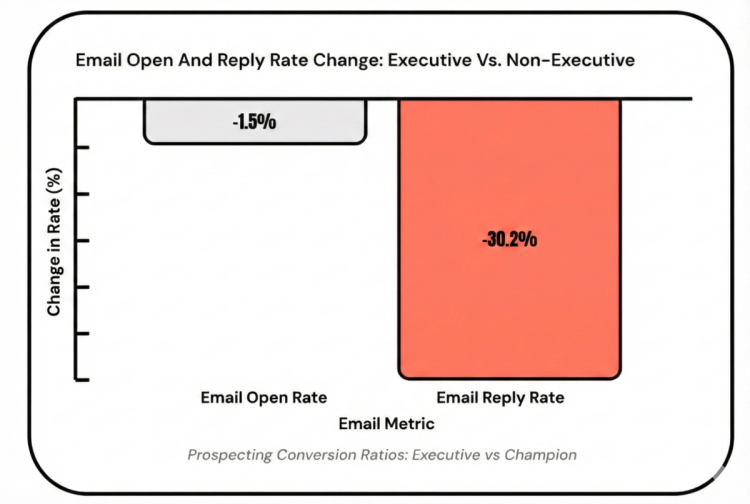
Gong Labs data show that C-level executives are 30.2% less likely to reply to cold emails than non-executives.
Not because they aren’t reading them, but because most emails fail to earn a response.
Most reps send emails that are too long, too product-focused, and disconnected from an executive’s priorities. As a result, those messages get filtered out long before a meeting is ever considered.
So what actually gets through an executive’s mental spam filter?
We analyzed 1M+ executive sales cycles in partnership with Gong and Jen Allen-Knuth (Sold $50M+ in enterprise sales, ex-Challenger) to determine exactly what it takes to land a meeting with an executive.
We’ll break down the data and tactics behind the best cold emails in 4 sections:
- Stop writing long emails and subject lines
- Fewer buzzwords and less ROI talk, more priorities and social proof
- Make an offer, not a meeting request
- The Problem Prompter Framework for cold emails
And if you like this, you’ll love the Ultimate Multithreading and Selling to the C-Suite Report that includes more than 20+ insights on how to close bigger deals with executives.
1. Stop writing long emails and subject lines
Executive buyers rely on a mental spam filter.
From the inbox view, they typically take less than three seconds to decide whether to open an email.
With that little time, subject lines can’t afford unnecessary words.
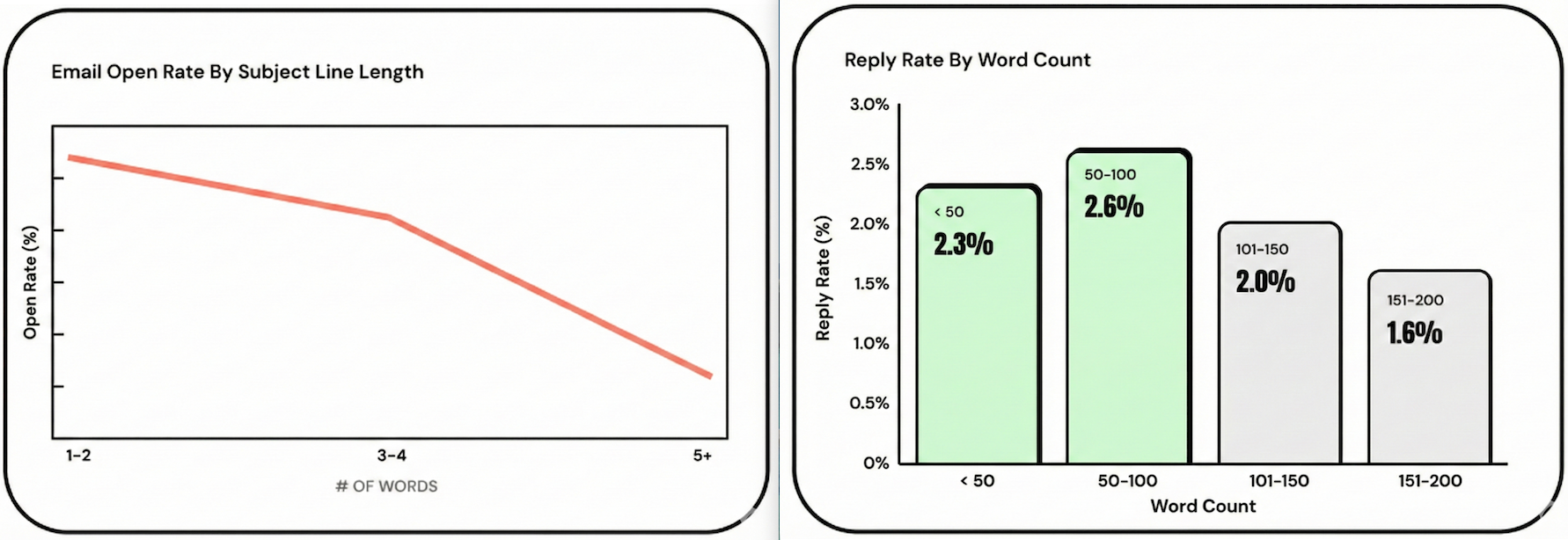
Gong data show that email open rates decline as subject lines get longer, with 1–4 words performing best.
The takeaway is simple: Keep subject lines short and anchored to the executive’s world.
For example, Jen would write a subject line “University achievement gaps” or “Student dropout risk” for an education executive.
If an executive does open your email, they typically spend no more than nine seconds reading it.
Gong data reveal that reply rates drop sharply once emails exceed 100 words.
The highest-performing emails land between 50 and 100 words.
We’ll review Jen’s framework that fits within those constraints shortly.
But remember, executives barely have time for their day job, let alone a long cold email.
2. Fewer buzzwords and less ROI talk, more priorities and social proof
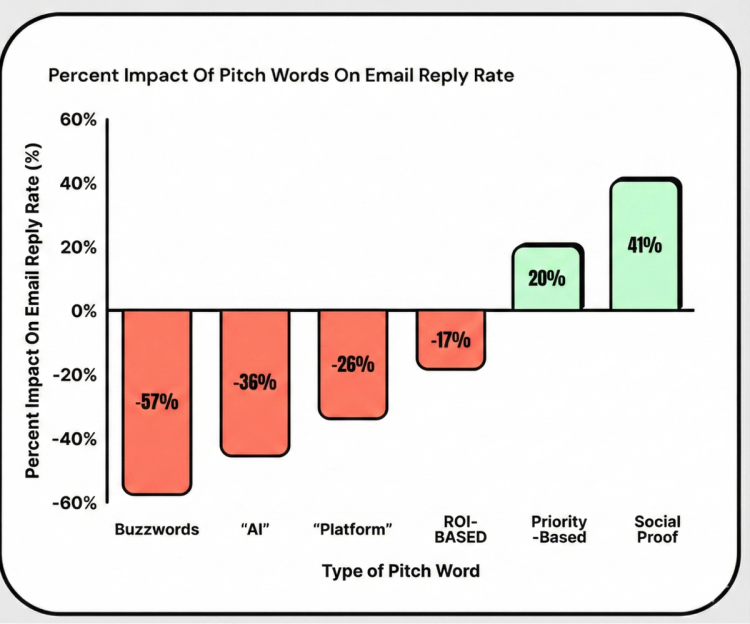
A typical executive receives hundreds of cold emails each day.
Jen cheekily calls this the “we-we” problem, in which sellers overuse language about their product, features, buzzwords, and marketing jargon…
Instead of the prospect’s problems.
Gong data show that emails filled with buzzwords and vague ROI claims significantly reduce reply rates.
So Jen always avoids terms like “AI,” “platform,” and feature-led positioning because it significantly lowers your chances of getting a reply.
What performs better?
Emails that focus on executive priorities and reinforce credibility through social proof.
For example, if an executive is focused on hiring, top-performing emails anchor the message to that initiative and reference how a similar organization addressed the same challenge.
3. Make an offer, not a meeting request
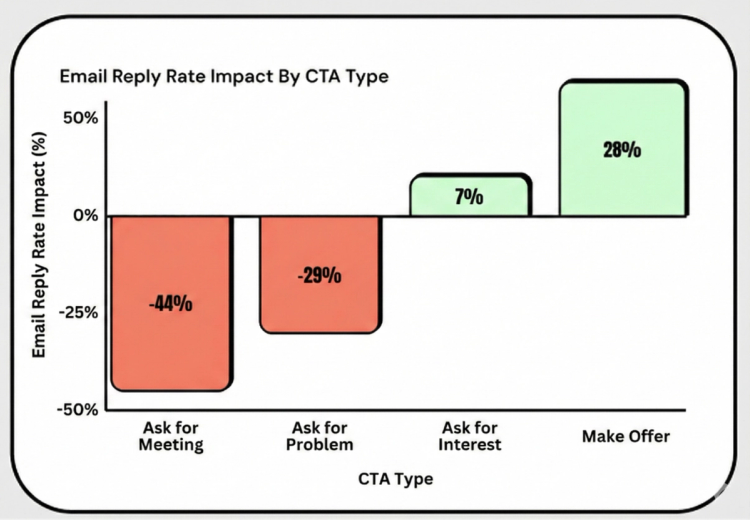
“I’d love to find 15 minutes on your calendar.”
Executives don’t need reminders that sellers would love to meet with them.
Jen explains that the last thing an executive wants to do is put another meeting on their calendar or answer discovery questions over cold email.
Instead of asking for a meeting or about a problem, Gong data indicate that your CTA should include an offer of value.
That means there needs to be a reason they should take a meeting, even if they never bought your product.
An offer of value includes something concrete, like a benchmark, insight, or perspective, showing that you understand the problems of the peers in their space.
For example, an effective offer CTA to an education executive might look like this:
We pulled together a brief benchmark showing how your university compares to peer institutions on student retention.
Open to reviewing it together?
Jen’s not asking for a sales meeting; she’s showing them how their peers are solving a similar problem that her prospects are experiencing.
4. The Problem Prompter Framework for cold emails
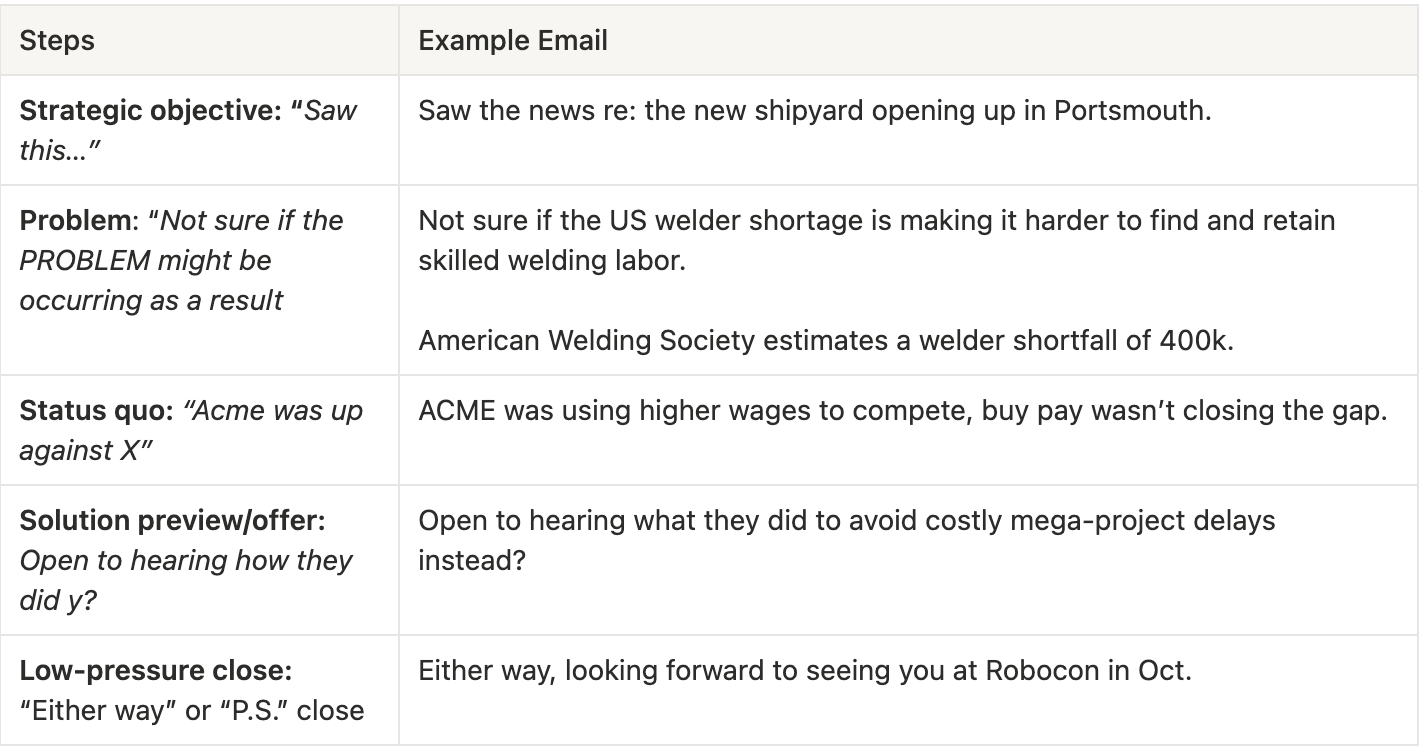
Now that we’ve covered what high-performing executive cold emails look like, let’s bring it all together using Jen’s Problem Prompter Framework.
Most sales emails lead with a product. This framework does the opposite.
Instead of pitching, it earns attention by prompting a real problem tied to an executive’s strategic priorities.
Here’s how it works, section by section:
- “Saw this…” — Lead with their strategic objective Start by referencing a priority the executive already cares about. This immediately signals relevance and shows you’ve done your research.
- “ACME was up against X” — Introduce the problem Call out the challenge that makes that objective harder to achieve. You’re building credibility by demonstrating you understand the pressure behind the goal, still without mentioning your product.
- “We’ve seen companies handle this by…” — Acknowledge the status quo Executives don’t change easily. By acknowledging how the problem is typically handled today, you validate their current approach and reduce resistance to considering something new.
- “Open to hearing how they did Y?” — Offer a new perspective Rather than asking for a meeting outright, offer insight into a different way the problem has been solved. The meeting becomes a means to explore a different approach to their problem — not a pitch of your product.
- “Either way” or “P.S.” close — Close with low pressure End with a light, respectful close. Whether it’s acknowledging their priorities or referencing a future event, this removes the typical sales pressure and keeps the interaction human.
Using this framework, your email stays focused on their priorities, their challenges, and a relevant perspective — all while prompting a problem that your solution can solve.
And because it’s designed to fit within 100 words or less, it aligns with how executives actually read emails, significantly increasing your chances of earning a reply.
The verdict: Cold emails are much harder with executives, but staying concise, leading with the prospect’s problem, and making an offer of value greatly increase your chances of booking a meeting.
Want more? The Ultimate Multithreading and Selling to the C-Suite Report breaks down exactly how top reps win more (and bigger) executive-level deals.
Follow Gong on LinkedIn and subscribe to the Gong Labs newsletter for data-backed sales insights that help you close more deals.
Director, Content Strategy and Research at Gong
For over a decade, Dan has provided revenue leaders with data and insights to inform and execute their GTM strategies. As a former analyst at Forrester Research, he worked with hundreds of B2B organizations to measure and improve sales productivity.
Win more with Gong
Loading form...
Discover more from Gong
Check out the latest product information, executive insights, and selling tips and tricks, all on the Gong blog.